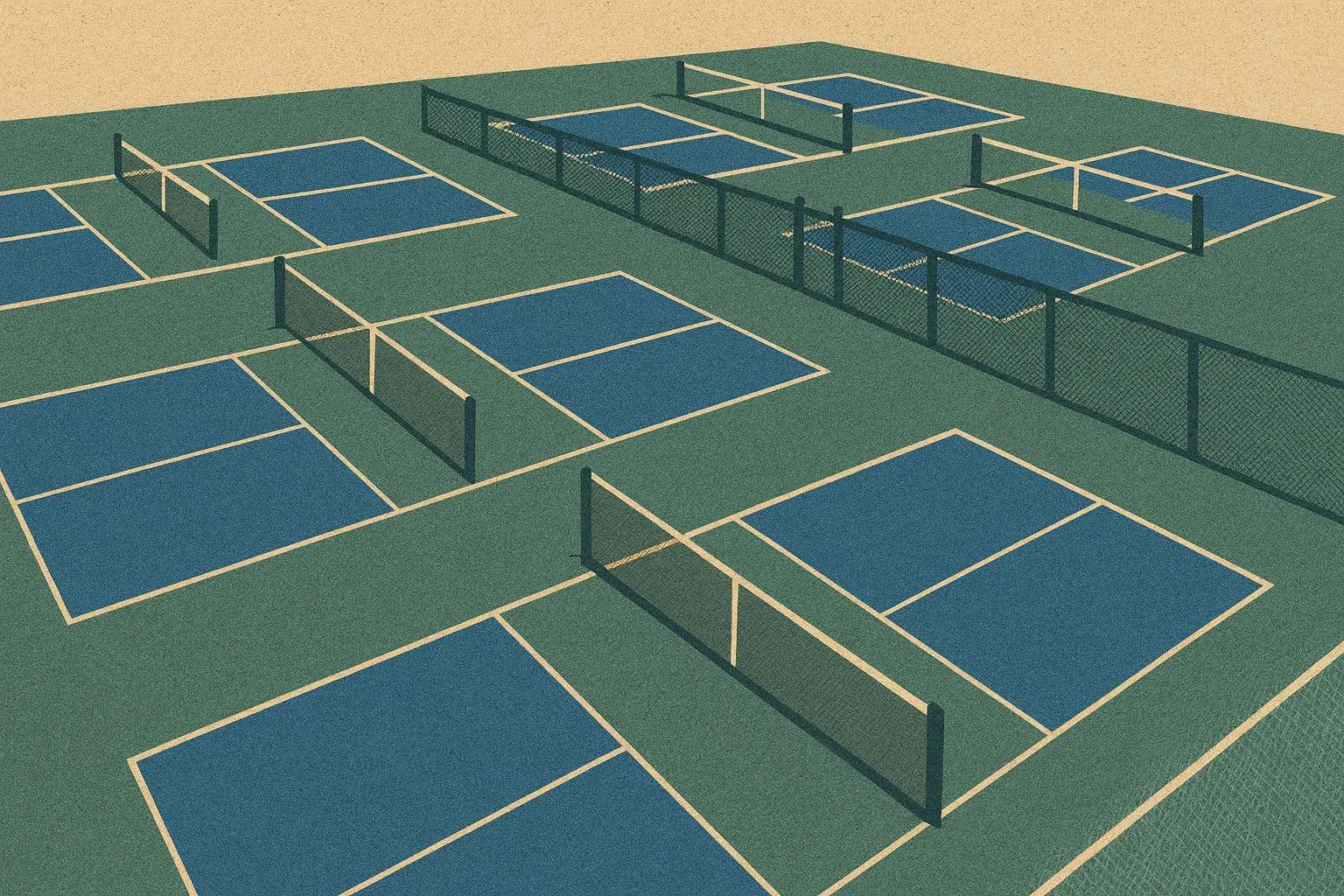
Pickleball has shed its “niche” label in record time. Not long ago, finding a place to play meant improvising on a borrowed tennis court or waiting on a lone gym schedule. Fast forward to today, and the pop of pickleballs echoes through neighborhoods coast to coast. Public pickleball courts have been sprouting up everywhere over the past five years, making it easier than ever to grab a paddle and play.
Pickleball Courts by the Numbers: A Five-Year Explosion
It’s no exaggeration to say pickleball is everywhere now. Just a few years back (late 2010s), there were roughly 21,000 known pickleball courts across the entire United States. That was already impressive growth from the sport’s earlier days, but what’s happened since has been nothing short of astonishing. By the end of 2022, the USA Pickleball database logged 44,094 courts nationwide, essentially doubling the court count in just a few years. And the trend only accelerated: as of early 2025, there are about 68,500 pickleball courts in the US. In other words, the number of places to play has roughly tripled in a five-year span!
To put this in perspective, pickleball has been the fastest-growing sport in America for four years running, and the infrastructure is racing to catch up. Throughout 2023 and 2024 alone, tens of thousands of new courts came online. USA Pickleball’s data (now powered by the Pickleheads court database) shows 18,455 new courts were added in 2024, on top of the thousands added in 2023. That’s an average of well over 1,000 new courts per month recently.
Perhaps one of the most eye-opening statistics comes from an urban parks report: in the 100 largest U.S. cities, the number of outdoor public pickleball courts skyrocketed 650% in the last seven years. According to the Trust for Public Land, those cities had just 420 outdoor courts in 2017; by 2024, they had over 3,000. Even from 2023 to 2024, total courts increased another ~14%. In plain terms, major city park departments are scrambling to lay down pickleball lines and nets as fast as they can.
Coast-to-Coast Growth and Standout Regions
One of the coolest things about pickleball’s rise is that it’s truly nationwide. A few hotspots stand out for their especially rapid expansion of public courts:
Sunbelt States (Florida, Arizona, California), It’s no surprise that warm-weather states lead in sheer numbers of courts. Florida and Arizona embraced pickleball early, particularly in retirement communities and parks where active seniors flock. California alone now has more than 3,500 known courts, the most of any state.
Pacific Northwest, As the birthplace of pickleball, the Pacific Northwest (Washington, Oregon) has strong roots in the game. What’s changed is the scale: where a few community centers in Seattle might have had courts a decade ago, now nearly every town park in the region has striped pickleball courts.
Midwest & Mountain States, Pickleball fever has caught on in the Midwest heartland and the Mountain West too. From Minneapolis to Denver, park leagues and open-play sessions are drawing crowds.
Northeast & Southeast, Even the traditional tennis strongholds of the Northeast have embraced pickleball in a big way. New York City, for instance, went from virtually zero dedicated public pickleball courts a few years ago to now having many courts in Central Park and other borough parks.
No Barriers: The New Era of Easy Access Pickleball

One of the driving ideas behind this boom is how accessible the game is. Pickleball’s rise has largely happened from the ground up, everyday folks setting up nets in driveways and local parks, rather than through exclusive clubs. The past five years have truly opened the floodgates for public play.
Think about other racket sports: tennis or squash often meant joining a club, paying for court time, or finding a friend with access. Pickleball flipped that script. Towns saw people of all ages wanting to play, and they responded by making space in public parks. Tennis courts have been converted en masse into pickleball courts. Empty parking lots, unused street hockey rinks, even old badminton courts, all have been fair game for conversion.
For the average Joe or Jane, this means opportunity. “I used to have to drive 30 minutes and pay $10 to get indoor court time,” one pickleball enthusiast in New Jersey recalls, “but now I can literally walk to my local park, and there are free courts and a bunch of people to play with.” Stories like that are common across the country.
Even where formal clubs exist, they’re often open. Recreation centers schedule pickleball drop-in hours that are either free or just a couple of bucks, a far cry from the exclusivity of, say, private tennis clubs. Pickleball’s ethos is community-oriented, and that’s reflected in these public spaces.
Of course, the surge in players did at first lead to crowded courts, lines of paddles waiting their turn, people joking that it’s like waiting for a table at a busy restaurant. In many places, that’s what prompted local officials to add even more courts. It’s a good problem to have: so many people want to play that we need more space!
Finding a Court Near You (It’s Really That Easy)
Given the growth, a newcomer today might wonder: How do I actually find a court or a group to play with? Fortunately, technology and community resources have kept pace. There are several apps and websites designed to help players locate courts and games. USA Pickleball’s own “Places 2 Play” database, now in partnership with Pickleheads, is a huge directory of courts. As of early 2023, it listed over 10,700 places to play across the U.S., and was growing by ~130 new locations every month!
This means that if you’re traveling or move to a new city, you can find a pickleball court almost as easily as finding a coffee shop. It’s become part of the landscape. One could argue that pickleball courts are the new community hubs; you see folks of all backgrounds showing up. “I love the community of pickleball players… it’s such a diverse group,” said one recreational player, noting that on any given day “an 80-year-old can play with a middle schooler” in this sport. That kind of intergenerational play happens most often on public courts during open play sessions. It’s exactly because those courts are accessible to everyone that you get this wonderful mix of people.
Another development making life easier: many parks and rec departments now have loaner gear or starter programs. Some public courts have a lockbox with community paddles for newcomers to borrow. Recreation centers often run free intro clinics. The whole ecosystem is geared toward lowering the hurdle for newbies.
Coaches and pros have noticed this shift too. Five years ago, a coach might have struggled to find an empty court to give a lesson or had to rent a tennis court and put temporary lines. Now, with so many new courts, scheduling lessons or clinics in public spaces is much simpler.
From Pickup Games to Pros: A Pickleball Democracy
The rise of public pickleball courts has fundamentally changed the sport’s trajectory. It’s taken pickleball from country club corners to everyman’s (and everywoman’s) game. You can be an average Joe or Jane who saw some people playing at a park, decided to try it, and boom, you’re part of the community the next day. Consider the story of Ana, a 42-year-old from North Carolina: she had never played a paddle sport in her life until 2021. A friend invited her to a free outdoor pickleball meet-up. Ana showed up a bit nervous in running shoes and borrowed a paddle, but within minutes she was hooked. “Everyone was so friendly and welcoming, I didn’t feel out of place at all,” she says. Soon, she was a regular at the public courts every Tuesday night, relishing the exercise and camaraderie.
Even seasoned athletes and coaches are benefitting from this democratization. A high school tennis coach in California shared how he’s seen some of his former tennis players get into pickleball after graduation because it was easier to find a casual game. “The public courts are packed with people of all skill levels, so my players could just blend in and play for fun without the formality of tennis clubs,” he noted. This coach has even started incorporating pickleball into off-season training, meeting his team at the local park’s pickleball courts for some cross-training and variety.
The broad access also means that talent can emerge from anywhere. There are stories of pickleball pros who first learned on neighborhood courts because they couldn’t afford club tennis as kids. Now those pros are giving back, often appearing at public parks for exhibition matches or clinics. The ethos is very much “grow the game by keeping it open and fun.” The past five years have cemented that ethos into actual infrastructure.
Game On: The Future is Bright
In 2025, stepping onto a pickleball court is as simple as heading to your nearest park, a far cry from just a few years ago. The data doesn’t lie: tens of thousands of public courts, triple-digit percentage growth, and new facilities being planned every month. But beyond the numbers, it’s the human stories that truly highlight the impact. Communities have been brought closer as neighbors meet on the courts; grandparents are teaming up with grandkids; strangers become friends after a few games. The phrase “meet me at the courts” has entered the everyday lexicon in towns across America.
So here’s to the new normal: a sport accessible to all, fueled by public enthusiasm and civic support. With the way things are going, finding a court in the U.S. will only get easier from here. The next time someone says “let’s play pickleball,” chances are you won’t have to look very far to find exactly where to go. Game on!