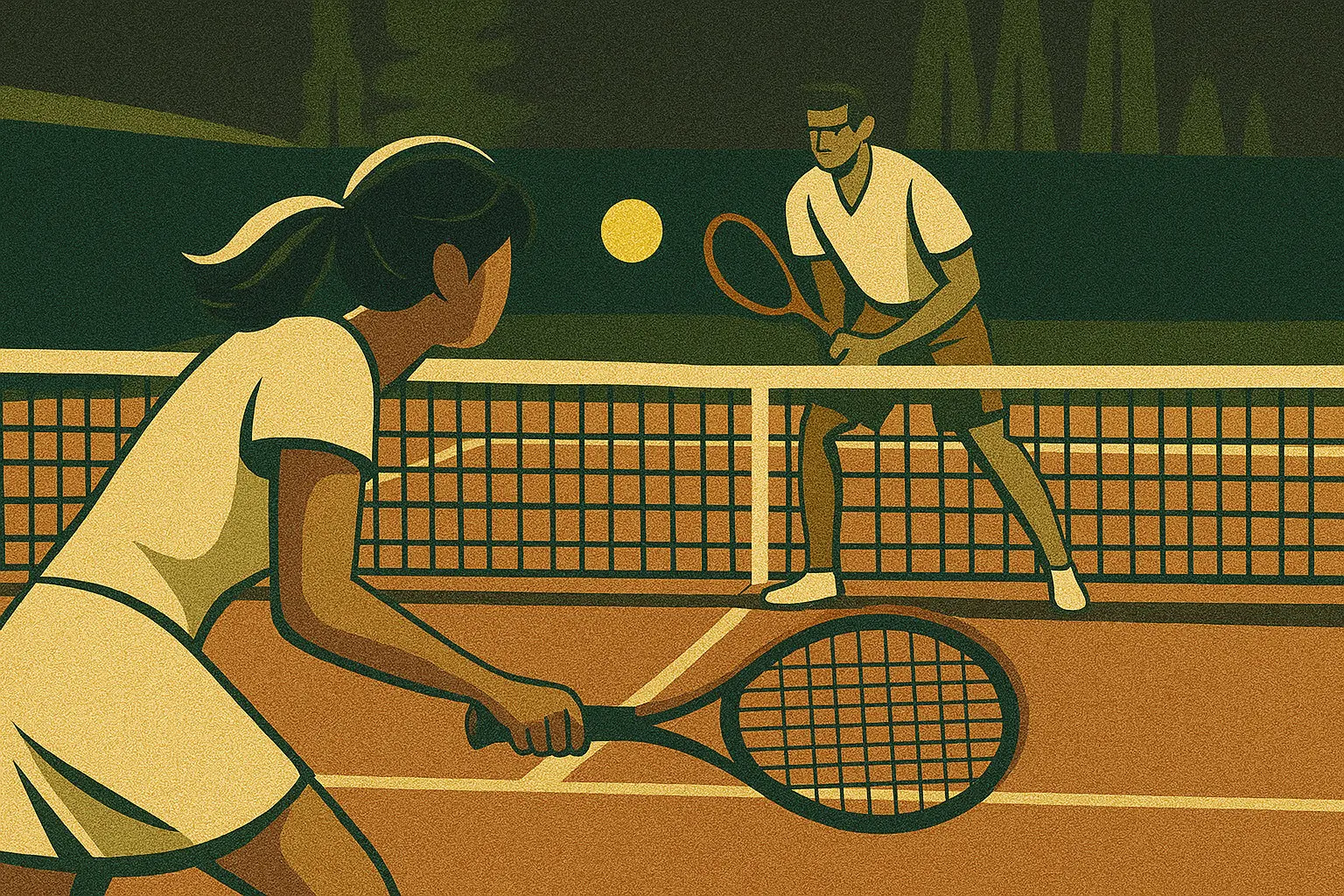
The last serves have been struck, the final trophies of the year have been hoisted, and the pros are finally... on vacation. After a grueling 11-month season, you'll see them posting pictures from beaches and mountains, their rackets finally getting a well-deserved rest.
For most of the world, this signals the end of tennis season. It's getting a bit colder, the weekly leagues are wrapping up, and it’s tempting to hang up your racket, too.
But here’s the secret the pros know: the "off-season" isn't an end. It's a beginning.
While the pros rest, your pre-season is just getting started. For adult beginners and amateur league players, these next few months are the single biggest opportunity you have all year to transform your game.
This isn't the time to stop playing; it's the time to start improving.
Forget the pressure of winning league matches. This is your time to rebuild, refine, and return next spring as a completely different player. We’re going to break down exactly why this quiet season is your secret weapon, what you should be working on, and how 1-on-1 coaching is the cheat code to making it all happen.
The "No-Pressure" Advantage: Why This Is Your Moment
Think about your last league match. You shanked a few backhands, your first serve percentage was... let's say "aspirational," and you kept dumping that easy volley into the net. You knew what was wrong, but you couldn't fix it. Why?
Because in the middle of a match—or even in a fast-paced group drill—you’re focused on one thing: not losing the point.
The regular season is all about competing. The off-season is all about building.
This is your time to work in a no-pressure, low-stakes environment. You have the freedom to fail, which is the only way to learn. You can finally dedicate an entire hour to that wonky serve toss without worrying about double-faulting on match point.
Even the pros do this. Their off-season is short, but they use it for "physical recovery and skill refinement". They don't just rest; they "fine tune, set goals and work towards them". They’re shoring up weaknesses and building new strengths—and so should you.

The Pro Playbook: What to Actually Work On
Okay, so you're sold on using the off-season. But what does that mean? Just playing more matches?
Not exactly. This is your chance to stop playing tennis and start training for it. It's time for deliberate, focused practice. Here’s what to steal from the pro's off-season playbook.
1. Deconstruct and Rebuild One "Weapon"
Instead of trying to fix everything at once, pick one shot that will make the biggest difference in your game.
For Beginners: This might be the forehand. You're going to learn the right grip, the proper "low-to-high" swing path, and how to use your body, not just your arm.
For Amateurs: This is your chance to fix your biggest liability. Is it your second serve? Your backhand slice? Your net play? Imagine going into next season with your greatest weakness turned into a reliable strength.
This is where 1-on-1 coaching is a game-changer. A group clinic has to cater to eight different people. A private coach can spend an entire hour with you just on your serve. They can break it down, film it, and rebuild it, piece by piece.
2. Master Your Footwork (The "Unseen" Game)
Here's a hard truth: the biggest difference between a 3.0 player and a 4.0 player isn't usually their shots. It's their feet.
The off-season is the perfect time to work on the "unseen" game:
The Split-Step: Training yourself to do this every single time your opponent strikes the ball.
Recovery: Not just hitting the ball, but moving back to the center of the court.
Positioning: Learning where to stand for a serve, a return, and in the middle of a rally.
This is tedious work that you’ll never focus on in a "fun" social match. But a good private coach will bake it into every drill, forcing you to move with purpose until it becomes an unconscious habit.
3. Build Your "Tennis Fitness"
The pros use the off-season to build strength, mobility, and flexibility to prevent injuries. Amateurs should do the same. You don't need a pro's gym, but you can use this time to:
Improve your stamina so you're not gassed in the third set.
Work on agility and balance drills.
Focus on "safe technique" to avoid the dreaded tennis elbow or rotator cuff issues.
A private coach is also a technical expert who can spot and fix the inefficient movements in your strokes that are not only costing you power but are putting you at risk for injury.
The 1-on-1 Difference: Your Off-Season "MVP"
So, why not just join a cheap group clinic? Clinics are great for socializing and hitting a lot of balls. But if your goal is rapid, tangible improvement, the off-season is all about 1-on-1 coaching.
A private lesson is, as one expert calls it, "the single most effective way to fine-tune your tennis skills".
It’s 100% Customized to Your Goal
In a group, you’re stuck doing "whatever drill the coach planned." In a private lesson, the entire hour is built around you.
You set the agenda: "Today, I only want to work on my backhand return."
You learn at your pace: There's no pressure to keep up with others or boredom from waiting for them.
You get a plan that is "suited to your specific goals, requirements, and existing ability levels".
You Can Finally Fix Your Bad Habits
Bad habits are almost impossible to break in a group setting. A coach who is splitting their focus can't give you the "detailed, in-depth analysis" you need.
A private coach's only job is to watch you. They will spot the tiny, game-killing flaws you've had for years:
"Your grip is shifting right before you hit your forehand."
"You're tossing your serve too far behind you."
"You're not bending your knees on your volley."
They can stop the drill, correct it, and make you rep it 50 times in a row until the new, correct muscle memory starts to form.
The Feedback is Instant and Constant
Think about the feedback loop.
Group Clinic: You hit a bad shot. 20 seconds later, you hit another. 10 minutes later, the coach wanders by and says, "Try to watch the ball."
Private Lesson: You hit a bad shot. Immediately, the coach says, "You dropped your head. Let's do it again. Keep your chin up." Hit. "Better." Hit. "That's it!"
This constant, real-time feedback is how you build new skills quickly. It's the difference between practicing and perfecting.
You Build Real, Earned Confidence
Nothing is more frustrating than feeling stuck. A private coach is your personal advocate. They are invested in your success. This "undivided attention" not only fixes your technique but also builds your mental game.
As Serena Williams said, "One important key to success is self-confidence. An important key to self-confidence is preparation".
One-on-one lessons are the ultimate preparation. You're not just hoping your serve goes in; you know it will because you've spent hours with a coach grooving it. You walk onto the court next spring with a totally new level of self-belief, one that you've truly earned.
Your Off-Season Action Plan (It's Simple)
Ready to make this your most productive off-season ever? Don't overcomplicate it.
1. Set ONE Specific Goal.
Don't just say, "I want to get better." Be specific.
"I want to add a reliable slice backhand to my game."
"I want to win 70% of my net points."
"I want to develop a second serve I can trust."
2. Find Your Coach.
Don't just pick the club pro. The right coach is someone who matches your goals and personality. This is where TeachMe.To comes in. You can browse vetted, qualified tennis coaches near you, read reviews from other players, and find someone who specializes in exactly what you want to learn.
3. Practice Between Your Lessons.
Your coach gives you the blueprint, but you have to do the homework. This is a concept we see in all sports, from soccer to basketball: the work you do on your own reinforces what you learned in the lesson. As the legendary Roger Federer put it, "There is no way around the hard work. Embrace it. You have to put in the hours because there's always something which you can improve". Even 20 minutes of shadow-swinging in your living room or practicing your toss in the backyard makes a huge difference.
Don't Wait for Spring
The pros are on a beach. The league players are packing it in. The courts are quiet.
This is your time.
Don't be the player who shows up in April with the same game, the same weaknesses, and the same frustrations. Be the player who put in the work when no one was watching.
The players who dominate the league in May are the ones who started their season today.