Most parents asking "when should kids start playing football?" want a single number. The honest answer is that no single age works for every child, and the right starting point depends more on the type of football than the birthday. The American Academy of Pediatrics does not set a universal start age for tackle football, instead focusing on risk reduction strategies like technique training, rule changes, and limiting contact in practice (AAP, 2015/2020).
What the research does support: introducing football through skills-based and flag programs early, then treating tackle as a later decision based on your child's physical and emotional readiness, coaching quality, and your family's comfort with risk.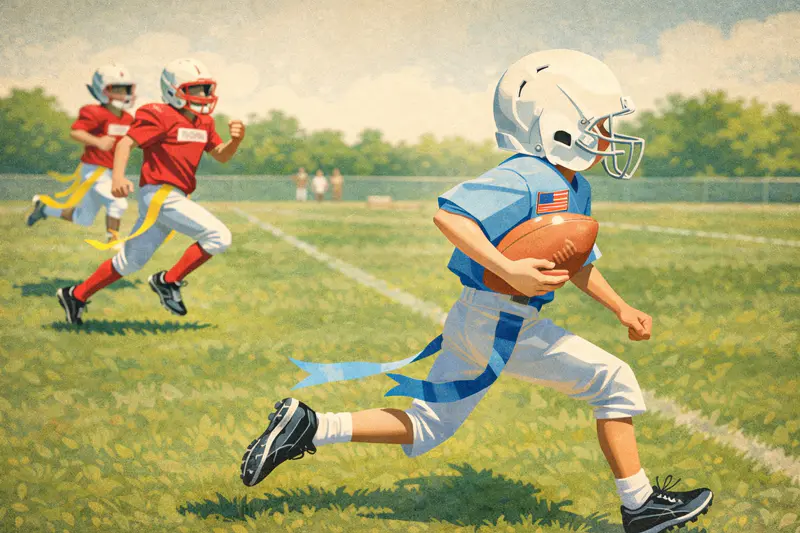
Quick answer: the best age depends on the type of football
Kids as young as four can start learning football fundamentals (throwing, catching, running routes) in structured, non-contact settings. NFL FLAG programs serve athletes ages 4 through 17, and many local leagues offer introductory divisions for kindergartners. These early experiences are about movement literacy and fun, not competition.
Flag football is the most common organized entry point, typically from ages 5 to 9. Tackle football becomes a more realistic conversation around ages 13 to 14 for families who choose it, though some leagues offer controlled contact as early as 10 or 11. The key distinction: skills and flag football build the foundation that makes any future tackle play safer.
What "ready" looks like (it's not just age)
A six-year-old who listens to instructions, follows simple rules, and enjoys group activities is probably ready for a flag program. A different six-year-old who struggles to stay engaged for 20 minutes may need another season of backyard play first. Age is an easy shorthand, but readiness is what actually predicts a good experience.
Parent-observable readiness checklist:
Attention span: Can your child follow two- or three-step instructions and stay engaged in a group activity for 30 to 45 minutes?
Basic coordination: Can they run, change direction, catch a ball sometimes, and throw with a general target in mind?
Coachability: Do they respond to adult feedback without shutting down or becoming defiant? Correction is constant in football.
Emotional regulation: Can they handle losing a play, sitting out a rotation, or making a mistake without a meltdown?
Interest: Does your child actually want to play, or is the enthusiasm coming entirely from a parent?
No child will check every box perfectly. You are looking for a baseline, not perfection.
Best age to start football by stage
The table below summarizes recommended formats and focus areas by age band. Details for each stage follow.
Ages 4 to 6: introduce football through movement and ball skills
At this stage, the goal is exposure, not development. Sessions should be short (30 to 45 minutes), heavy on games, and light on structured drills. Think relay races with a football, simple toss-and-catch, and running through cones.
Kids this age are learning how their bodies move. Expecting them to memorize plays or hold positions is unrealistic. The best programs at this level look a lot like organized recess with a football theme.
Ages 7 to 9: flag football and basic positions
This is where organized flag football shines. Children in this range can start understanding offense versus defense, learn what a route looks like, and begin grasping turn-taking and team structure. The non-contact format lets them build spatial awareness and reaction speed without collision risk.
Coaches should teach safe falling and body control, even in flag. Kids trip, collide accidentally, and dive for flags. Learning to absorb ground contact safely transfers to every sport, not just football.
Ages 10 to 12: advanced flag, controlled contact prep, and strength basics
Players who have been in flag for a few seasons are ready for more complex schemes, longer practices, and introductory conditioning work. Bodyweight exercises (push-ups, planks, bear crawls) build the core and neck strength that reduce injury risk if they eventually move to tackle.
If your family is considering tackle in the near future, this is the stage to focus on technique. Proper tackling form, blocking posture, and how to absorb contact can all be taught in controlled, drill-based settings before full-speed gameplay. The emphasis should be on repetition at low speed, not live hitting.
Ages 13 to 14+: tackle becomes a more realistic option for some families
By this point, many young athletes have the physical development, sport-specific skills, and emotional maturity to handle full contact. This does not mean every 13-year-old should play tackle. It means the conversation becomes more reasonable at this age.
Treat tackle football as a family risk decision. Evaluate the specific program's coaching credentials, practice contact limits, equipment standards, and concussion protocols. A well-run tackle program with trained coaches and enforced safety rules is a fundamentally different experience than a poorly supervised one.
Flag vs tackle: how to choose for a first season
The CDC compared head impacts in youth tackle versus flag football among athletes ages 6 to 14. The findings are stark: tackle football athletes sustained 15 times more head impacts than flag football athletes during practices and games. High-magnitude head impacts were 23 times more frequent in tackle. The median number of seasonal head impacts was 378 per tackle athlete compared to just 8 per flag athlete (CDC, 2025).
The CDC's interpretation: non-contact or flag football may be a safer alternative for reducing head impacts and concussion risk for youth football athletes under 14.
From a learning perspective, flag football teaches most of the same cognitive skills as tackle. Players learn routes, reads, defensive positioning, and teamwork. What flag removes is collision, which also removes the primary injury mechanism. For a first season at any age, flag gives your child more repetitions of actual football decision-making with significantly less physical risk.
If your child is set on tackle, ask these questions first:
Has the coaching staff completed a recognized safety certification (USA Football Heads Up, for example)?
Does the program limit full-contact practice time?
Is there a written concussion protocol, and do coaches follow it?
Does your child have at least one to two seasons of flag or skills training?
A "yes" to all four makes the tackle decision more defensible. A "no" to any of them is a reason to wait.
Safety basics parents should insist on (any age)
Regardless of format, certain safety standards are non-negotiable:
Qualified coaching: Coaches should hold current safety certifications and maintain first-aid readiness.
Rules enforcement: Officials or supervising adults must enforce rules consistently, including penalties for illegal contact in flag.
Hydration and heat plans: Programs should have scheduled water breaks, shaded rest areas, and a policy for modifying or canceling practice in extreme heat.
Supervision ratios: Young players need enough adults on the field to monitor form, fatigue, and behavior.
Emergency action plan: Every practice and game site should have a plan for medical emergencies, including who calls 911 and where the nearest AED is located.
Concussion basics: what to watch for and what to do
Concussion symptoms can appear immediately or be delayed by hours or even days. The CDC's HEADS UP program lists observable signs and symptoms parents should know:
Signs a coach or parent might notice: confusion, slow responses, balance problems, mood or behavior changes, inability to recall events before or after the hit.
Symptoms a child might report: headache, nausea, dizziness, blurry vision, sensitivity to light or noise, feeling "foggy" or "off."
Danger signs requiring emergency care: one pupil larger than the other, extreme drowsiness or inability to wake, worsening headache, repeated vomiting, slurred speech, seizures, or increasing confusion.
Immediate action steps:
Remove the player from practice or the game.
Do not let them return to play the same day.
Seek evaluation from a healthcare provider experienced with concussion.
Return-to-play: the minimum standard after a suspected concussion
The CDC outlines a 6-step return-to-play progression. Each step takes a minimum of 24 hours, and the player must be symptom-free before advancing to the next step. If symptoms return at any stage, the player drops back to the previous step.
A healthcare provider must give written clearance before the athlete returns to full contact. No exceptions, regardless of how good the child says they feel. Youth brains are still developing, and returning too soon carries the risk of prolonged recovery or second-impact syndrome.
Equipment: what kids need and how fit should feel
Flag football equipment is minimal: a mouthguard, cleats, and a flag belt (usually league-provided). Some programs recommend soft-shell headgear, though it is not universally required.
Tackle football equipment includes a helmet with facemask, shoulder pads, mouthguard, thigh and knee pads, hip pads, cleats, and athletic support. NFL Play Football's equipment checklist is a useful reference for the full list.
Fit is where most parents fall short. A helmet that slides when the player shakes their head, or shoulder pads that ride up into the neck, create risk rather than reduce it. USA Football's equipment fitting guidance stresses that helmets should sit one inch above the eyebrows, fit snugly without pressure points, and have the chin strap fastened at all times.
Check equipment before every season. Kids grow fast, and last year's helmet may not fit this year's head.
How to find a good youth football coach (and avoid red flags)
The quality of coaching is the single biggest variable in your child's football experience. A great program with average facilities will serve your child far better than a flashy organization with careless coaching.
Positive signals:
Current safety certification from a recognized body (USA Football, NFHS, or equivalent).
Structured practice plans with clear warm-ups, skill segments, and cooldowns, not just scrimmaging.
Age-appropriate drills that match the developmental stage of the players.
Contact limits that are stated upfront and enforced, especially for practice.
Open communication with parents about philosophy, schedule, and how injuries are handled.
Red flags:
No visible credentials or refusal to discuss safety training.
Excessive contact in practice, especially for players under 12.
Winning-first mentality that pressures injured players to return or ignores skill development in favor of game results.
Dismissiveness toward parent questions about safety, playing time, or practice structure.
No concussion protocol or a vague "we handle it" response when asked.
Ask to observe a practice before committing. Thirty minutes of watching will tell you more than any website or brochure. Youth football leagues like Pop Warner organize divisions by age and sometimes weight, so confirm your child's placement and the contact rules that apply to their division.
When private lessons make sense (before joining a team)
Joining a team can feel overwhelming for a child with no football background. Twelve new kids, a coach shouting unfamiliar terms, and drills they have never seen create a recipe for frustration and quick dropout.
Private football lessons offer a controlled environment where a child can learn fundamentals at their own pace. Throwing mechanics, catching technique, route running, defensive stance, and even safe body contact can all be introduced one-on-one before the child faces the chaos of a group setting. For kids who are hesitant, smaller, or simply new to the sport, a few sessions with an experienced instructor can build the confidence and baseline skills that make team participation productive.
Private instruction is also useful for older kids transitioning from flag to tackle. Learning proper tackling form in a controlled, low-speed setting with an attentive coach reduces the risk of developing bad habits that lead to injury.
Booking football lessons through TeachMe.to
TeachMe.to connects families with local football instructors for private and small-group lessons. The booking process is straightforward: browse available coaches in your area, review their background and teaching focus, and book a session that fits your schedule.
When you book, share your child's age, experience level (none, flag only, some tackle), and what you are hoping to work on. Whether that is first-time fundamentals for a five-year-old or tackling technique for a 13-year-old preparing for a school team, giving the instructor context upfront means the session is tailored from the start.
Private lessons through TeachMe.to work well as a bridge: a few sessions to build skills and confidence before a team tryout or first flag season, or as supplemental training alongside an existing program.