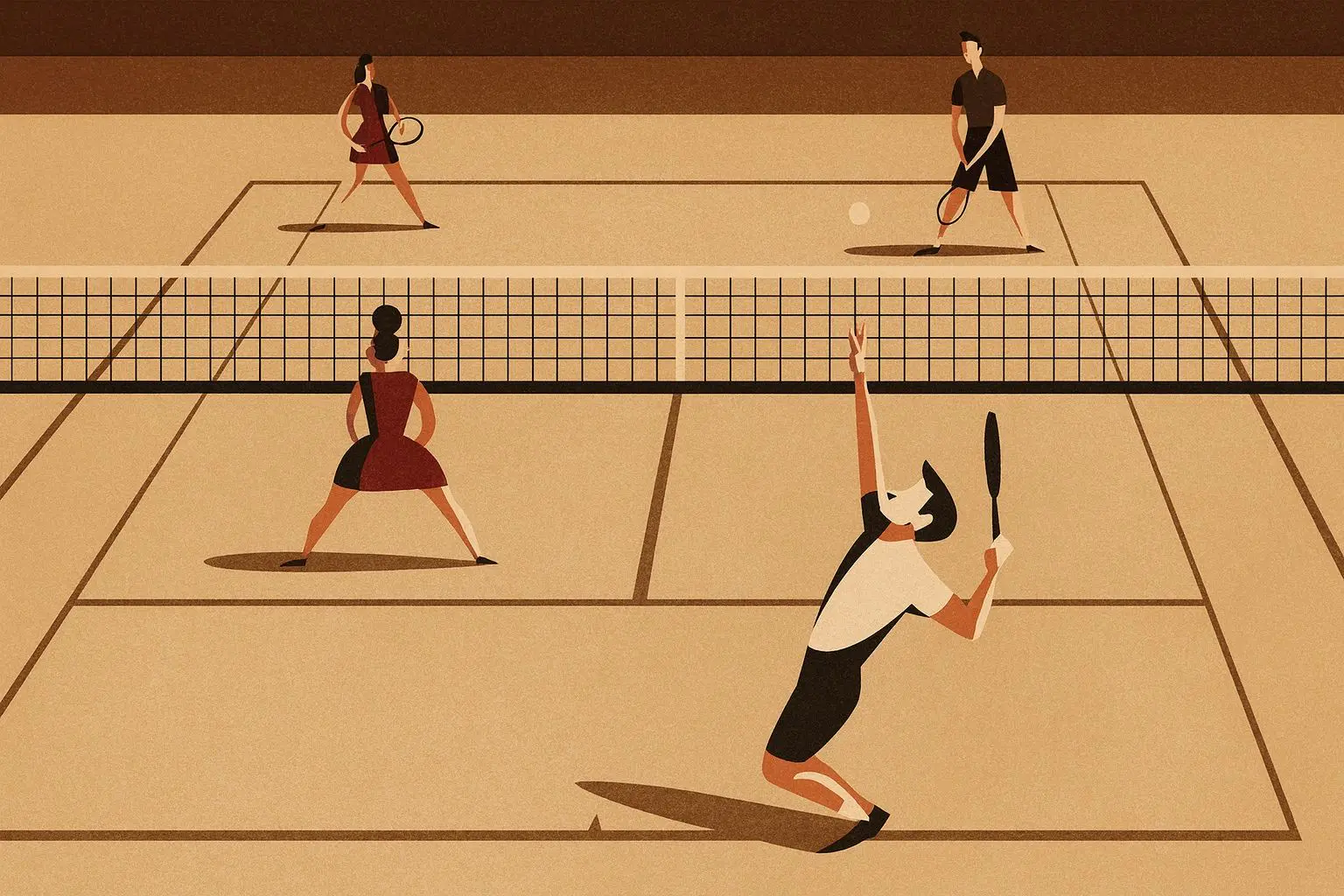
The US Open has never seen a mixed doubles event quite like this. In 2025, what is usually a laid-back side tournament was transformed into a high-octane showcase of tennis superstars, all compressed into two days of action during Fan Week before the main tournament. What do you get when you take some of the world’s top men and women, pair them up across the net, and throw in a faster scoring format and a million-dollar prize? A recipe for an electrifying new twist on a Grand Slam classic.
2025 Mixed Doubles Revamp at a Glance:
Smaller Draw: Only 16 teams (down from the usual 32) competed, making it an exclusive field packed with talent.
Fan Week Showcase: All matches were held during US Open Fan Week alongside qualifying rounds. Admission was free, drawing big crowds looking for a sneak peek of star players.
Faster Matches: Matches used a short-set format, first to 4 games wins a set (tiebreak at 4–4), with no-ad scoring (one decisive point at deuce). If teams split sets, they played a 10-point match tiebreak instead of a full third set.
Star-Studded Teams: The draw was filled with big names. Many of the world’s top singles players signed up to play mixed. We saw pairings like Iga Świątek & Casper Ruud, Carlos Alcaraz & Emma Raducanu, Elena Rybakina & Taylor Fritz, Novak Djokovic & Olga Danilović, Paula Badosa & Stefanos Tsitsipas, Naomi Osaka & Gaël Monfils, and more. Even the defending 2024 mixed champs, Sara Errani & Andrea Vavassori, returned as a wildcard team amid the all-star lineup.
Big Prize Money: With an eye-popping $1 million awarded to the champions, the mixed doubles suddenly became one of the most lucrative titles in tennis.
What Changed in 2025: A Fast, Fan-Friendly Format
Traditionally, mixed doubles at Grand Slams has been a 32-team draw that plays out over the two weeks of the main tournament, often on smaller courts, late in the schedule, and without much fanfare. In 2025, the U.S. Tennis Association ripped up that playbook. The mixed doubles event was moved to the very start of the US Open, taking place on Tuesday and Wednesday of Fan Week. By doing so, organizers gave mixed doubles “center stage” when it would normally be overshadowed by singles.
The format itself got a radical makeover to fit into two days. Matches were short and sweet: best-of-three sets, but each set was a race to 4 games instead of 6. If a set reached 4–4, a tiebreak decided it on the spot. The no-ad scoring rule meant no prolonged deuce games, at 40–40, the next point won the game. And if teams split the first two sets, they didn’t play a full third set; instead, it was straight to a first-to-10 match tiebreak to determine the winner.
These changes dramatically sped up the pace of play. Sets could be over in 15 or 20 minutes. In fact, the defending champs Errani and Vavassori won their opening set in just 19 minutes. More matches could be packed into a short window, and there was a constant stream of action on the show courts.
Another big change was who got to play. Entry was no longer first-come, first-served based on combined doubles rankings. Instead, the top 8 teams by combined singles ranking earned direct entry, ensuring marquee names were in the mix. The remaining 8 teams were chosen by wild cards, and notably, the USTA made a point to pick players who were already in the singles field, partly to avoid scheduling conflicts with those still trying to qualify in singles. The end result was a field almost entirely composed of well-known singles stars. As US Open tournament director Stacey Allaster put it, the goal was to “make the game more accessible and entertaining for our fans” and showcase “the world’s best men and women competing side-by-side” in a fast-paced, highly competitive format.
Big Names and Unlikely Pairings: Mixed Doubles Goes Hollywood

The entry list for the 2025 US Open mixed doubles looked like something from a tennis fan’s wild dream. It was packed with headline names, many of whom had never or rarely played mixed doubles before. In past years, mixed doubles draws typically feature doubles specialists and a few singles players having fun. Not in 2025, this time it was designed as a star attraction.
Just to name a few of the eye-catching teams: reigning men’s singles champ Carlos Alcaraz teamed up with 2021 US Open champ Emma Raducanu. Novak Djokovic, the 23-time major champion, joined forces with Olga Danilović, it was surreal for many to watch Djokovic playing mixed doubles at the US Open, something he’d never done before. Iga Świątek, then world No.2 on the women’s side, paired with Norway’s top male Casper Ruud. America’s sweetheart Jessica Pegula paired with British rising star Jack Draper as the top-seeded team. Former US Open champ Naomi Osaka teamed up with showman Gaël Monfils, creating a team rich in talent and personality. On the American side, five-time US Open singles winner Venus Williams partnered with the towering server Reilly Opelka. And anchoring the field were Sara Errani & Andrea Vavassori, the Italian duo who won the title in 2024.
Quick, Thrilling, and Upset-Friendly Tennis
If anyone thought a shortened format would be less intense, they were proven wrong very quickly. In fact, the fast pace led to some big upsets and wild matches right off the bat. With only four games needed to snag a set, there was little room for error, one hot streak or a couple of lucky points could swing the whole match. This unpredictability was on full display in the first round. Fans expecting all the super-teams to dominate were in for surprises: Carlos Alcaraz and Emma Raducanu, despite their combined five Grand Slam titles, got bounced out in their opening match. So did the No.2 seeded duo of Taylor Fritz and Elena Rybakina, both top-10 singles players, they ran into the savvy Italian pair Errani/Vavassori early and didn’t survive the short-set shootout. Even the great Novak Djokovic, playing mixed doubles at a Slam for the first time in his career, found himself ousted in his opener with partner Danilović. In a format like this, there’s no warm-up or settling in; matches can be over almost as soon as they start, so every point matters. As one commentator noted, it was “blink and you miss it” tennis, and that made for edge-of-your-seat viewing.
Players had to adjust quickly to the no-ad points and the match tiebreaks. Some thrived under the pressure. The defending champions Errani/Vavassori, who have loads of doubles experience, actually seemed to relish the format, they cruised through some sets in dominating fashion.
That’s not to say the singles stars didn’t adapt, many of them rose to the challenge after a jittery start. Świątek and Ruud, for instance, got through a tight opening set in their first match and then started clicking as a team. They actually enjoyed the quick format; with Iga fresh off a tournament win just 48 hours earlier, the short matches probably felt like a nice change of pace. Pegula and Draper, the top seeds, also found their groove and showed why they were seeded No.1, they absolutely crushed one quarterfinal match 4-1, 4-1 against the teenage phenom Mirra Andreeva and former #1 Daniil Medvedev.
And the Winners Are...
When the dust settled Wednesday night, the last team standing was none other than Sara Errani and Andrea Vavassori; they successfully defended their US Open mixed doubles title, beating the superstar combo of Iga Świątek and Casper Ruud in a thrilling final match. The final score was 6–3, 5–7, [10–6], which tells you how close it was. The Italians took the first set, nearly clinched the second, then had to shake off a surge from Świątek/Ruud who forced a deciding super-tiebreak. In that 10-point tiebreak, Errani and Vavassori’s cohesion under pressure shone through; they leapt out to a 4–0 lead and never let go, ultimately sealing the victory with a perfectly measured passing shot from Vavassori on match point.
In the trophy ceremony, the Italian duo was gracious and clearly emotional. Errani and Vavassori thanked the organizers for giving them the chance to play, and even thanked each other with big smiles, emphasizing how much fun they had on court together. Errani turned to the stands and said, “I think this one is also for all the doubles players that couldn’t play this tournament”, dedicating their win to those peers who were left out of the reimagined event.
From Skepticism to Cheers: How Fans and Players Reacted
The audience reaction to the new mixed doubles format was a story in itself. Before the event, there was plenty of debate among tennis fans: Was this just a gimmick? Would the singles players even try hard? Were doubles specialists being treated unfairly?
Players who initially had reservations came around once they saw the enthusiasm. After his second-round win, Andrea Vavassori, who had been one of the most vocal critics beforehand, admitted that there were “positives and negatives” but “the positives are for sure that the stadium was packed... It’s a great thing for doubles to be seen by more people. I have to give them credit... this format is great for doubles and mixed doubles to develop in the future.” That’s a 180-degree turn from his stance a month earlier, and it was echoed by others. Suddenly, mixed doubles was cool.
Fans in the stadium absolutely loved it. Many were families and younger spectators who came for the novelty and star power, but ended up genuinely invested in the matches. The free entry during Fan Week meant a lot of locals who might not normally attend the Open came to check it out, and they were treated to a heck of a show.
Television and media reactions were mixed at first, but as the event unfolded, most commentators acknowledged it as a success. ESPN devoted significant coverage to mixed doubles for the first time, with prime slots on ESPN2 and highlights on SportsCenter. The narrative of “doubles specialists versus singles stars” and the inclusion of names like Djokovic, and Alcaraz made it an easy sell to audiences. By the time Errani and Vavassori lifted the trophy, the skepticism had largely given way to celebration.