Your child wants to play volleyball. Maybe they watched a match at a family barbecue, or their best friend just joined a league. Either way, you're wondering what kids actually need to learn, and when. This guide breaks down age-appropriate skills, essential drills, safety training, and how to pick the right program so your child builds real ability (and has a blast doing it).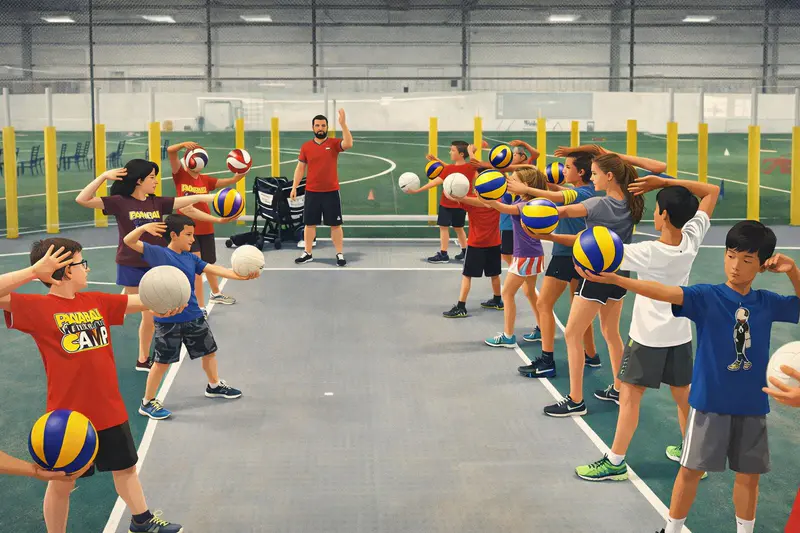
Age-Appropriate Volleyball Skills Development Timeline
Not every skill belongs at every age. A 7-year-old trying to master a jump serve is a recipe for frustration and bad habits. Youth volleyball training works best when it matches what a child's body and brain can actually handle.
The American Academy of Pediatrics recommends sport-specific skill training begin around age 6, with competitive play phased in gradually. Here's what that looks like on the volleyball court:
This timeline isn't rigid. Some kids develop faster physically; others pick up tactics more quickly. The best kids volleyball classes adjust to the child, not the other way around.
Ages 6-8: Foundation Movement and Ball Familiarity
At this stage, the volleyball itself is almost secondary. What matters: Can your child move confidently, track a ball in the air, and play cooperatively with others?
Good beginner volleyball for kids programs at this age look more like structured play than formal practice. Think balloon volleyball (keeping a balloon in the air with open hands), tossing and catching with a soft training ball, and basic shuffling games that build lateral movement.
The goal is ball familiarity without fear. A regulation volleyball is too heavy and too hard for most 6-year-olds. Quality programs use foam balls or lighter training volleyballs and lower the net (or skip it entirely). If your child leaves practice smiling and asking when they can come back, the program is working.
Ages 9-11: Core Techniques and Rules Introduction
This is where volleyball coaching for children starts to look like actual volleyball. Kids in this range can begin learning proper passing stance (knees bent, arms together as a platform), underhand serving technique, and simple setting with correct hand position.
Introduce rules gradually. Start with rally scoring, basic rotation, and the three-hit rule. Don't dump the entire USA Volleyball rulebook on a 10-year-old. Instead, add one new rule concept per week and reinforce it through play.
Light competition can enter the picture around age 10 or 11 for most kids. Short sets (to 15 instead of 25), smaller courts, and mixed-ability teams keep things fun while building competitive instincts.
Ages 12-14: Advanced Skills and Strategy Concepts
By 12, many kids are ready for the full game. Overhand serving, spike approaches, basic blocking, and position specialization all become appropriate. This age group can handle tactical concepts: where to place a serve, when to tip instead of spike, how to read the opposing team's formation.
This is also when preparation for school volleyball programs matters most. Middle school and freshman teams expect players who can serve consistently, pass accurately, and understand rotation. Kids who've built solid fundamentals through structured youth volleyball skills training have a significant edge.
Essential Volleyball Fundamentals Every Child Must Master
Regardless of age, volleyball success comes down to a handful of core skills. The order matters. Rushing to spiking before a child can pass reliably creates a player who looks flashy in warmups but falls apart in games.
Understanding the four stages of skill development helps parents set realistic expectations. Here are the fundamentals, ranked by priority:
Serving: From Underhand to Overhand Progression
Underhand serve first. Always. It builds the toss timing, contact point awareness, and follow-through that transfer directly to the overhand serve later.
Step-by-step underhand serve technique:
Stand with the non-dominant foot slightly forward
Hold the ball in the non-hitting hand at waist height
Draw the hitting arm back with a straight elbow
Step forward while swinging the arm like a pendulum
Contact the ball with the heel of the hand (not a fist)
Follow through toward the target
Common problems and fixes:
Ball goes into the net: The child is contacting too high on the ball. Cue them to "hit the belly button of the ball."
Ball sails out of bounds: Too much arm swing with an open hand. Focus on a firm wrist and controlled follow-through.
Inconsistent toss: Have them practice the toss 20 times without hitting. Consistency here fixes most serving issues.
Move to overhand serving when a child can land 7 out of 10 underhand serves in the court from the full service line.
Passing and Setting: Building the Foundation of Team Play
Passing (the forearm bump) is the single most important skill in volleyball. A team that can't pass can't do anything else.
Forearm pass essentials:
Feet shoulder-width apart, knees bent, weight on the balls of the feet
Arms together with thumbs parallel (not clasped in a fist)
Contact the ball on the forearms between the wrists and elbows
Move the platform with the legs, not by swinging the arms
Setting requires softer hands and quicker decision-making. For kids under 11, "catching and releasing" the ball overhead is a perfectly acceptable starting point. Clean, legal sets develop with hand strength and repetition.
The 80/20 rule of youth volleyball: About 80% of practice time should focus on passing and serving. These two skills determine the outcome of most rallies at the youth level.
Partner drill to try: "Pass-set-catch." Two players stand 10 feet apart. Player A passes to Player B, who sets it back. Player A catches. Repeat 10 times, then switch roles. Simple, effective, and it teaches the rhythm of a real rally.
Attacking and Blocking: Developing Power and Timing
Spiking is what kids want to learn. But it's the most complex skill in volleyball, combining a multi-step approach, a vertical jump, arm swing timing, and hand contact.
When is a child ready to spike?
Can approach with a left-right-left (or right-left-right for lefties) footwork pattern
Can jump and land safely on two feet
Has enough shoulder strength to swing overhead without pain
For most kids, this readiness arrives between ages 10 and 12. Before that, standing hits and downball attacks build arm swing mechanics without the injury risk of full approach jumps.
Blocking follows a similar timeline. Start with proper footwork along the net and correct hand positioning (fingers spread, arms pressing over). Contact with the ball during blocking comes later, once timing and positioning feel natural.
Critical Safety Skills and Court Awareness Training
Parents ask about skills and strategy. They should also ask about safety. According to the National Federation of State High School Associations, volleyball ranks among the top 10 high school sports for injury rates, with ankle sprains and knee injuries leading the list.
Good volleyball instruction for youth builds safety into every session, not as an afterthought.
Proper Landing and Falling Techniques
Every jumping drill should include landing instruction. Kids need to land on two feet, with knees bent, absorbing impact through their legs rather than locking out. Teach this before the first spike approach.
Falling safely matters too. Volleyball players dive, sprawl, and roll. Teaching kids to absorb ground contact with their forearms and chest (not wrists or elbows) prevents fractures and sprains. "Pancake" drills, where kids slide a flat hand under a low ball while controlling their descent, build this skill progressively.
Net Safety and Court Boundaries Understanding
Collisions at the net cause some of the worst youth volleyball injuries. Teach two rules early:
Your side is your side. Never reach under the net or step into the opposing court.
Call the ball. Vocal communication ("mine!" or "got it!") prevents two players from crashing into each other.
Mark court boundaries clearly during practice. Use cones or tape so kids develop spatial awareness before moving to regulation courts.
Game Rules and Strategy Concepts for Young Players
Basic Scoring and Rotation Systems
Start simple. Rally scoring means every rally earns a point for someone. First to 25 wins a set (or 15 in a deciding set). Games are best of 3 or best of 5.
Rotation confuses kids more than any other rule. Use a numbering system: assign each player a number 1-6 and physically walk them through the rotation pattern before playing. After three practices with numbered positions, most kids grasp the clockwise flow.
Teamwork and Communication Skills
Volleyball is one of the most communication-dependent team sports for kids. Every rally requires calling the ball, directing teammates, and covering positions. These skills transfer well beyond the court, which is one reason one-on-one coaching across sports often emphasizes verbal communication as a core competency.
Teach three phrases first: "Mine," "Help," and "Free ball." Build from there.
Essential Drills and Practice Activities by Skill Level
Beginner Drills: Building Confidence and Basic Skills
Wall passing: Stand 5 feet from a wall, pass the ball against it, and catch. Repeat. Once consistent, remove the catch and pass continuously.
Toss-hit-catch triangle: Three players form a triangle. One tosses, one hits (underhand), one catches. Rotate after 5 attempts.
Shuttle run with ball: Shuffle laterally across the court while holding a volleyball overhead. Builds footwork without the pressure of ball contact.
Intermediate Drills: Combining Skills and Adding Challenge
Serve and pass pairs: One player serves from mid-court (not the full line), the other passes back to a target. Track successful passes out of 10.
Pepper: Two players alternate bumping, setting, and hitting to each other. The classic volleyball warmup drill, and still one of the best for developing touch.
3v3 mini-games: Half-court, rally to 10, all three hits required. Forces passing, setting, AND attacking in every rally.
Advanced Drills: Game Situation Practice
Serve-receive to attack: Full sequence from serve to pass to set to hit. Rotate servers every 5 attempts.
Defensive positioning walkthroughs: Coach hits balls to specific zones while players practice reading and reacting from their assigned positions.
Situation scrimmages: Start each rally from a specific scenario (down by 3, game point, out of rotation) to build mental toughness.
Choosing the Right Volleyball Program for Your Child
Recreational vs. Competitive Programs: What's Right When
Recreational programs prioritize participation, fun, and broad skill exposure. Every kid plays every position. Winning is secondary. These programs work best for ages 6-10 and for any child still figuring out whether they love the sport.
Competitive (club) programs demand more time, money, and commitment. Tryouts, travel tournaments, and position specialization are standard. Most volleyball coaches recommend competitive play no earlier than age 11 or 12.
A good rule of thumb: If your child asks to compete more, they're probably ready. If you're pushing them toward it, they probably aren't.
When evaluating costs, understanding what families typically spend on private sports coaching provides helpful context. Volleyball programs generally range from $100-$300 per season for recreational leagues and $1,500-$4,000+ annually for competitive club teams.
Evaluating Coaching Quality and Program Structure
Ask these five questions before signing up:
What's the coach-to-player ratio? Anything above 1:10 for skill sessions means less individual feedback.
What certifications does the coach hold? Look for USAV (USA Volleyball) IMPACT certification or CAP (Coaching Accreditation Program) levels.
How is practice structured? Quality programs balance skill work, game play, and conditioning. Red flag: all scrimmage, no instruction.
What's the playing time policy? For recreational programs, equal playing time should be non-negotiable.
How does the program handle skill differences? Good programs differentiate instruction. Poor ones teach to the middle and lose kids on both ends.
Comparing group versus private coaching options can also help you decide whether supplemental individual instruction would benefit your child alongside team practices.
Equipment and Gear Essentials for Young Volleyball Players
Required vs. Recommended Equipment by Age Group
You don't need much to start. That's one of volleyball's biggest advantages.
Skip the expensive gear until your child commits to the sport. A $15 foam volleyball and clean gym shoes are enough for the first few months.
Safety Gear and Protective Equipment Considerations
Knee pads become essential once kids start diving and floor defense. That typically happens around age 10-11. Look for pads that fit snugly without restricting movement. Too loose and they slide; too tight and they cut circulation during play.
Proper volleyball shoes matter more than most parents realize. Running shoes have elevated heels designed for forward motion. Volleyball requires lateral movement, jumping, and quick stops. Court shoes with flat, grippy soles and ankle support reduce injury risk significantly.
Ankle braces are worth discussing with your child's coach if they have a history of ankle sprains. Many competitive programs recommend them as standard preventive gear.
Common Challenges and Solutions in Youth Volleyball Training
Overcoming Fear and Building Confidence
Fear of the ball is real and common, especially for kids under 10. A volleyball traveling at even moderate speed can sting, and kids remember that.
The fix isn't to tell them "it won't hurt." It's to build progressive exposure:
Start with foam balls or partially deflated volleyballs
Toss gently from close range so the child controls contact
Gradually increase distance and speed as confidence grows
Celebrate contact, not perfection
Shy kids often thrive in smaller group settings where they're not lost in a crowd of 20. A few private sessions with a patient coach can build enough confidence to make group practices enjoyable. When progress stalls, understanding how coaches help learners push through plateaus gives parents a framework for patience and realistic expectations.
Dealing with Skill Development Plateaus
Every young athlete hits a wall. They've been improving for weeks, and suddenly nothing seems to click. This is normal, and it's actually a sign that the brain is consolidating new motor patterns.
What helps: Changing the practice environment. Play beach volleyball. Try setting against a wall with the non-dominant hand. Practice with a heavier ball for 10 minutes, then switch back. Novel challenges re-engage the learning process.
What doesn't help: Doubling practice time, adding pressure about improvement, or comparing your child to teammates. Plateaus pass. Your job is to keep showing up.
Your child doesn't need to become a Division I recruit to benefit from volleyball lessons. The coordination, teamwork, communication, and confidence they'll build on the court will serve them for years, whether they play through high school or move on to other passions. The best time to start? Whenever they're curious enough to pick up a ball.
Find a local volleyball coach and book your child's first lesson at TeachMe.To.
Find a Volleyball Coach Near You
Ready to get started? Browse local volleyball coaches and book your first lesson.