Soccer Skills for Kids by Age: Complete Development Guide for Youth Players (2026)
Your 6-year-old just came home from soccer practice, kicked a ball into the garage door, and announced they're "basically Messi now." You love the enthusiasm. But you're also wondering: what should kids actually be learning at each age, and when does real position play start?
Here's the truth most youth soccer programs won't tell you. The skills your child needs at age 5 look nothing like the skills they need at age 10. Pushing advanced tactics on a kindergartner is like teaching algebra before they can count. And yet, well-meaning parents and coaches do exactly this every weekend across the country.
This guide breaks down soccer skills for kids by age group, explains when position play actually begins, and gives you specific drills to support your child's development at every stage. Whether your kid just started chasing the ball in a pack or is ready for competitive tryouts, you'll know exactly what to focus on and what to ignore.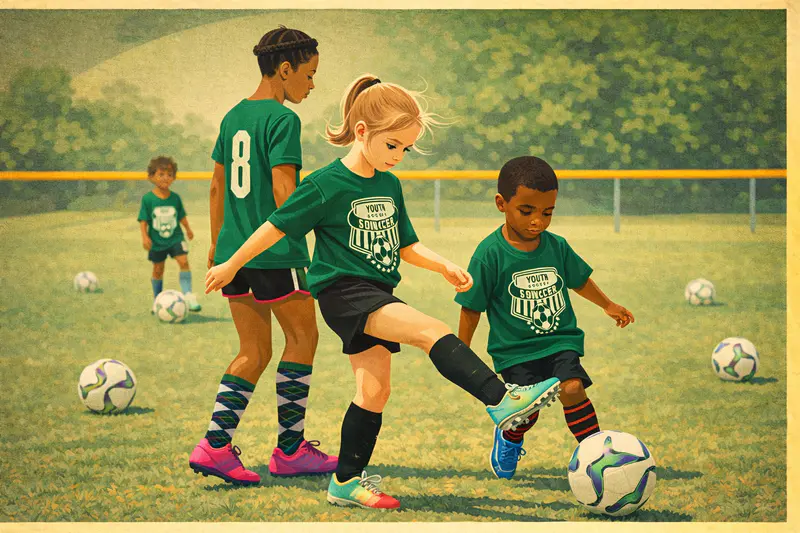
Understanding Youth Soccer Development: Foundation Principles
Kids soccer development follows a predictable pattern, but it doesn't follow a rigid schedule. Every child develops at their own pace. The mistake most parents make is comparing their 7-year-old to the best player on the travel team and panicking.
The concept of physical literacy matters here. Physical literacy is a child's ability to move confidently and competently in a wide variety of physical activities. Before your child can execute a perfect instep pass, they need to be able to run, jump, balance on one foot, and change direction without falling over. These aren't soccer skills. They're movement skills. And they're the foundation everything else sits on.
The Long-Term Athlete Development (LTAD) model, developed by Sport for Life, identifies key stages of youth athletic growth. For soccer, the most relevant stages are:
Notice that sport-specific training doesn't even begin until around age 9 in this framework. Everything before that? It's about building a movement-literate kid who happens to enjoy kicking a ball.
Physical vs. Cognitive Development in Young Soccer Players
A 5-year-old's legs can run fast. Their brain cannot process "overlap the right winger and deliver a cross to the back post." That disconnect between physical ability and cognitive understanding is the single biggest thing parents and coaches misread.
Physical milestones to watch for:
Can run and stop on command (ages 4–5)
Can kick a stationary ball with some accuracy (ages 5–6)
Can dribble while looking up occasionally (ages 7–8)
Can receive a pass and redirect it intentionally (ages 8–9)
Can execute skills under pressure from a defender (ages 10–12)
Cognitive milestones to watch for:
Understands basic rules like "kick toward that goal" (ages 5–6)
Recognizes open space and moves toward it sometimes (ages 7–8)
Reads simple game situations (2v1, when to pass vs. dribble) (ages 9–10)
Understands positional responsibilities and team shape (ages 11–12)
When cognitive ability catches up to physical ability, that's when real soccer begins to emerge.
The Myth of Early Specialization in Youth Soccer
If your neighbor's kid is on a "select" team at age 6 and training four days a week, you might feel behind. You're not.
The American Academy of Pediatrics recommends that children avoid single-sport specialization until at least age 15–16. Research consistently shows that early specialization increases injury risk, leads to burnout, and doesn't produce better athletes long-term. Kids who play multiple sports through age 12 actually develop broader athletic abilities that transfer beautifully to soccer.
A child who plays basketball develops court vision. A kid who swims builds cardiovascular endurance. A gymnast builds core strength and body awareness. All of these feed directly into becoming a better soccer player later.
The bottom line: If your child is under 10, the best "soccer training" might include soccer twice a week and another sport the rest of the time.
Essential Soccer Skills by Age Group: Complete Breakdown
This is the section you came here for. Below is a detailed breakdown of what soccer skills kids should be learning at each developmental stage.
Ages 3–5: Pre-Soccer Foundation Skills
At this age, there is no soccer. There is only play. And that's exactly how it should be.
Focus areas:
Running in different directions
Stopping and starting on command
Balancing on one foot for 3–5 seconds
Rolling a ball with hands, then feet
Kicking a stationary ball (any part of the foot is fine)
Basic coordination games (hop, skip, gallop)
The goal at ages 3–5 is ball familiarity, not ball mastery. Let them kick it around the backyard. Play tag. Roll the ball back and forth. If your child is smiling, you're doing it right.
Ages 6–7: Introduction to Ball Skills
Now we can start calling it "soccer." But barely.
Key skills to introduce:
Dribbling with the inside of the foot (walking pace first, then jogging)
Passing to a stationary target (parent, cone, wall)
Stopping the ball with the sole of the foot
Shooting at a large target from close range (5–8 yards)
Basic 1v1 defending (standing between the attacker and goal)
Throw-ins (yes, proper throw-in technique starts here)
At this stage, practices should be 45–60 minutes max with at least half that time spent in small-sided games (3v3 or 4v4). The ratio of playing to drilling should heavily favor playing.
What 6-year-olds don't need: corner kick strategies, offside explanations, or lectures about "defensive shape." Save your breath.
Ages 8–9: Fundamental Technique Development
This is where real youth soccer training begins. Kids at 8–9 can follow multi-step instructions, understand basic cause-and-effect, and start to connect practice with performance.
Skills to develop:
Dribbling with both feet (not just the dominant foot)
Passing with the inside of the foot to a moving target
Receiving the ball and turning with it
Shooting with the laces (instep drive)
Basic heading (only with age-appropriate lightweight balls)
Shielding the ball from a defender
Simple 2v1 decision-making (pass or dribble?)
This is also the age where teamwork concepts start clicking. Kids begin to understand that passing to an open teammate is often smarter than dribbling through three defenders. Often. Not always.
Ages 10–12: Advanced Fundamentals and Position Awareness
Between 10 and 12, everything accelerates. This is the "Learn to Train" window identified in the LTAD model, and it's the most important period for soccer skill acquisition.
Advanced skills to build:
Weak-foot proficiency (comfortable using either foot)
First-touch quality under pressure
Crossing from wide areas
Volleys and half-volleys
Tactical awareness (when to switch play, how to create space)
Set piece fundamentals (corners, free kicks)
Position-specific responsibilities (see next section)
Kids at this age can handle 60–90 minute sessions and benefit from structured technical work combined with tactical game scenarios. This is also when a private soccer coach can make a significant difference, because individual feedback accelerates progress faster than team training alone.
When Do Kids Start Learning Soccer Positions? Age Guidelines
Parents ask this constantly: "When should my kid learn to play a specific position?" The short answer is around ages 9–10 for basic positional concepts, and 11–13 for genuine position specialization.
Before age 9, most youth soccer programs (and US Soccer's own guidelines) use small-sided formats specifically designed to avoid rigid positioning. The reasoning is simple. When kids are locked into positions too early, they only learn a fraction of the game.
The Evolution from Small-Sided to 11v11 Games
Youth soccer formats progress intentionally:
Ages 4–6: 4v4 (no goalkeeper) — Everyone plays everywhere. Maximum touches on the ball.
Ages 7–8: 7v7 — Basic shape emerges (defenders, midfielders, forwards), but kids rotate through all positions.
Ages 9–10: 9v9 — Clearer positional structure. Kids start identifying preferences.
Ages 11–12: 11v11 — Full-field play with defined positions and tactical responsibilities.
Each format teaches different things. In 4v4, every player must dribble, pass, defend, and score. There's nowhere to hide. By the time kids reach 11v11, they've ideally developed enough all-around skill that choosing a position is about preference and fit, not about compensation for missing skills.
Position Specialization Timeline: What Parents Should Expect
Ages 7–9: Kids might say "I'm a striker!" because they like scoring. That's fine. But coaches should rotate them through every position during this stage. A kid who only plays forward never learns to defend. A kid who only defends never learns to create.
Ages 10–11: Players start gravitating toward positions that match their physical and mental attributes. Quick, creative kids may prefer wing play. Tall, strong kids may enjoy center back. Organized, high-energy kids might thrive in midfield.
Ages 12–14: True specialization begins. Players refine position-specific skills, but smart coaches still encourage versatility. The best professional players in the world (think Jude Bellingham, who plays multiple midfield roles) were multi-position players through their youth.
A good rule of thumb: If your child's coach is demanding rigid position play before age 10, that's a coaching philosophy problem, not a development plan.
Recreational vs. Competitive Soccer: Development Pathways
Not every kid needs to play competitive soccer. And that's perfectly okay.
Recreational soccer (ages 4–10) focuses on fun, social connection, and basic skills. Games are low-pressure. Everyone plays. The goal is to build a love for the sport.
Competitive soccer (typically starting at ages 9–11) introduces tryouts, travel, more frequent training, and results-oriented play. It's a bigger commitment of time and money, and it's only worth pursuing if your child genuinely wants it.
As we've covered in our guide on the cost of soccer lessons in 2026, competitive pathways can get expensive quickly. Private coaching, tournament fees, and travel add up.
Signs Your Child is Ready for Competitive Soccer
Look for these indicators (physical, technical, and emotional):
Asks to practice on their own without being told
Handles losing without melting down
Seeks feedback and tries to apply it
Consistently outperforms peers in recreational settings
Commits to attending practices without constant negotiation
Shows coachability: listens, adjusts, tries again
If your child checks most of these boxes and is 9 or older, competitive soccer could be a great fit. If they're still working on emotional regulation or attention span, keep it recreational and let them grow.
Essential Practice Drills and Activities by Age
Fun Skills Games for Younger Players (Ages 4–7)
Shark Attack — One player (the shark) tries to kick everyone else's ball out of a defined area. Last player standing wins. Teaches: dribbling under pressure, awareness.
Red Light, Green Light with a Ball — Classic game, but players must dribble. "Red light" means stop the ball with the sole of the foot. Teaches: ball control, stopping technique.
Treasure Hunt — Scatter balls around a field. Players dribble one ball at a time back to their "treasure chest" (a cone square). Teaches: dribbling, turning, speed.
Partner Bowling — Set up cones as pins. Players take turns passing the ball to knock them down. Teaches: passing accuracy in a low-pressure format.
Musical Balls — Like musical chairs, but with one fewer ball than players. When music stops, players without a ball are out. Teaches: reaction time, ball possession.
Technical Drills for Developing Players (Ages 8–12)
Wall Pass Sequences — Find a wall. Pass with the inside of the right foot, receive with the left. Alternate. Progress to one-touch. Teaches: passing and receiving with both feet.
Cone Weave Dribbling — Set 6–8 cones in a line, 2 yards apart. Dribble through using inside/outside of both feet. Time it. Beat your record. Teaches: close control, weak-foot confidence.
3v1 Rondo — Three players keep possession in a small square while one defender tries to win the ball. Teaches: quick passing, movement off the ball, defensive pressure.
Shooting Circuit — Set up three stations at different angles around the goal. Player receives a pass, takes one touch, and shoots. Rotate stations. Teaches: first touch and finishing.
The value of one-on-one soccer coaching really shines in drill work, because a coach can correct technique in real time rather than after the fact.
Common Mistakes Parents and Coaches Make in Youth Soccer
Over-coaching from the sideline. When parents yell "Kick it!" or "Pass!" during games, they override a child's decision-making process. The kid learns to wait for instructions instead of reading the game. Watch. Cheer. Save the coaching for the ride home (briefly) or let the actual coach handle it.
Prioritizing winning over development. A team of 8-year-olds that wins every game by having their best player dribble coast-to-coast isn't developing anyone. Coaches who rotate positions, encourage risk-taking, and measure success by improvement rather than scorelines produce better players long-term.
Skipping the basics for flashy skills. Your 9-year-old doesn't need to learn a rainbow flick. They need to pass accurately with both feet. Fundamentals aren't exciting, but they're the difference between a player who plateaus at 12 and one who keeps improving through high school.
Training year-round without breaks. Burnout is real. Kids who play soccer 11–12 months a year with no off-season are more likely to quit by age 13, according to research from the Aspen Institute's Project Play. Build in rest periods. Let them miss soccer a little.
How to Support Your Child's Soccer Development at Home
You don't need a perfect setup. A ball, a wall, and 15 minutes of practice three times a week can make a noticeable difference within a month.
Practical tips:
Play with them. Pass the ball back and forth in the backyard. It doesn't have to be "training." Just kick around.
Encourage both feet. Have them brush their teeth with their non-dominant hand. It sounds silly, but it reinforces the idea of developing both sides.
Watch soccer together. Ask questions: "Why did that player pass instead of shoot?" Developing a soccer brain matters as much as developing soccer feet.
Don't over-schedule. Free play with friends (pickup games, street soccer, park kickarounds) is where creativity is born.
If you want structured guidance tailored to your child's level, working with a qualified local coach through TeachMe.To gives your kid personalized feedback that team practices simply can't provide.
Frequently Asked Questions About Youth Soccer Development
Q: What soccer skills should a 6-year-old learn?
A: At age 6, kids should focus on basic dribbling (moving the ball forward while walking, then jogging), stopping the ball with the sole of their foot, passing to a stationary target using the inside of their foot, and shooting at a large goal from close range. Technical perfection is not the goal. Comfort with the ball and enjoyment of the game are the priorities. Most 6-year-olds benefit from 45-minute sessions split between simple drills and small-sided games.
Q: At what age should kids start playing soccer positions?
A: Basic positional awareness (knowing where to generally stand) starts around ages 9–10 when kids move to 9v9 formats. True position specialization typically begins at ages 12–13 with the transition to 11v11 play. Before age 9, kids should rotate through all positions to develop a complete understanding of the game. Locking a 7-year-old into "left back" stunts their long-term growth.
Q: How often should kids practice soccer per week?
A: For ages 4–6, one to two sessions per week (30–45 minutes each) is plenty. Ages 7–9 can handle two to three sessions. Ages 10–12 can train three to four times per week, including games. Always include at least one full rest day. Quality beats quantity at every age.
Q: Should my child specialize in soccer or play multiple sports?
A: Play multiple sports through at least age 12. Research consistently shows that multi-sport athletes develop better overall athleticism, suffer fewer overuse injuries, and experience less burnout. Many elite professional soccer players (including Lionel Messi, who played futsal, and Alex Morgan, who competed in multiple sports as a child) credit diverse athletic backgrounds for their success.
Q: What are the basic soccer skills every child should learn first?
A: The five foundational skills, in priority order: (1) dribbling with control, (2) passing with the inside of the foot, (3) receiving and stopping the ball, (4) shooting with the laces, and (5) basic defending (staying between the attacker and the goal). Master these five before worrying about anything else. They account for roughly 80% of what happens in a youth soccer game.
Q: How do I know if my child is ready for competitive soccer?
A: Look for intrinsic motivation (they practice voluntarily), emotional resilience (they handle losing without shutting down), coachability (they listen and adjust), and consistent skill above recreational peers. Age 9–10 is the earliest most children are ready. If your child dreads practice or plays only because you want them to, competitive soccer will likely backfire.
Building a Long-Term Development Plan for Young Soccer Players
Youth soccer development is not a sprint. The players who reach the highest levels almost always had patient, supportive environments during their formative years.
Here's a realistic timeline for kids soccer development:
Ages 3–5: Fall in love with movement and the ball
Ages 6–8: Build a foundation of basic soccer skills through fun, varied activities
Ages 9–11: Develop technical proficiency, introduce tactical concepts, explore positions
Ages 12–14: Refine skills under pressure, commit to a position, decide between recreational and competitive pathways
Track your child's progress, but track the right things. Don't track goals scored. Track whether they're using both feet more than last month. Track whether they're looking up while dribbling. Track whether they're making better decisions with the ball.
And if you're serious about accelerating your child's development with expert guidance, find a local soccer coach on TeachMe.To who can create a personalized training plan matched to your child's age, ability, and goals. Because the best investment in youth soccer isn't a $300 pair of cleats. It's the right coach at the right time.
Find a Soccer Coach Near You
Ready to get started? Browse local soccer coaches and book your first lesson: