Ten years ago, telling someone you were a soccer fan in the United States might’ve earned you a polite nod and a quick change of subject. Fast forward to today, and it’s a whole different ball game. Soccer has quietly, then suddenly, exploded in popularity across America. You see it in packed stadiums, in Premier League games on TV every weekend, and in kids wearing Lionel Messi jerseys to school. And with two mega-tournaments, the 2025 FIFA Club World Cup and the 2026 FIFA World Cup, coming to U.S. soil, the soccer buzz is reaching a fever pitch.
A Decade of Growth: From Niche Sport to Next Big Thing
It’s no secret that soccer’s profile in the U.S. has grown by leaps and bounds over the past decade. Once considered a niche or “foreign” pastime, it’s now firmly part of the American sports scene. In fact, soccer recently surpassed ice hockey to become the fourth most popular sport among Americans. According to Gallup, 5% of U.S. adults now call soccer their favorite sport to watch, edging out hockey, and the gap between soccer and baseball (historically a national pastime) is narrower than ever. The demographics tell an even more exciting story: the average soccer fan in the U.S. is just 35 years old and nearly 70% of American soccer fans are under 40. In other words, the youth have spoken, and they’re chanting “USA! USA!” at soccer matches.
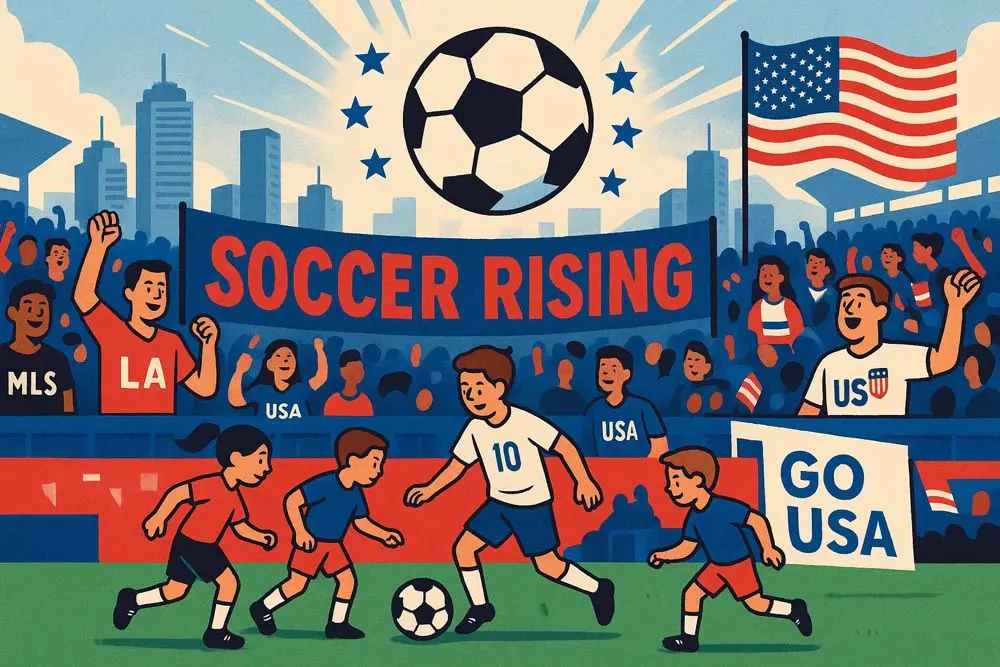
This surge is visible in the stands and on the airwaves. Major League Soccer (MLS) attendance has boomed, with new clubs and soccer-specific stadiums popping up nationwide. The league set a record in 2024 with an average of 23,234 fans per game, surpassing 11 million total spectators in a season for the first time. In Atlanta, for example, soccer isn’t playing second fiddle to anyone, Atlanta United FC regularly draws crowds in the 40-70,000 range. In March 2024, over 67,000 fans packed Atlanta’s Mercedes-Benz Stadium for a single match, one of the largest soccer attendances worldwide that day. It’s a scene that would’ve been unimaginable a decade ago. The energy in these MLS arenas is electric, complete with supporter sections singing and waving flags, proving that an authentic soccer culture has firmly taken root in the States.
And it’s not just domestic leagues. Americans are tuning into international soccer in record numbers. Premier League mornings, UEFA Champions League afternoons, these have become part of the weekly routine for millions of U.S. fans. In 2024, more than 50 million Americans watched international soccer matches that didn’t even involve a U.S. team, a whopping 60% increase in viewership compared to 2018. Think about that: even when “our” team isn’t playing, Americans are glued to the soccer screen. As one sports analytics report noted, fans in certain regions (like the South and West) have gone crazy for global leagues, e.g. viewership for Spain’s LaLiga in Texas and neighboring states jumped 120%+ in recent years. With virtually every major league now available on TV or streaming, it’s easier than ever to follow soccer, and Americans have embraced the world’s game with a passion. Long gone are the days when soccer was hard to find on TV; now you can catch everything from the English Premier League to Mexico’s Liga MX with a click. As a result, seeing Real Madrid and Barcelona jerseys on school playgrounds has become totally normal, and in some neighborhoods, futsal courts have even replaced old basketball courts, a literal shift in the sports landscape.
The face of the American soccer fan is also changing. Today’s soccer fandom is younger, more diverse, and increasingly inclusive. Many fans are newcomers to the sport, 17% of U.S. soccer fans say they only started following the game in the last five years. This new wave of supporters skews young (over one-third are under 25) and notably, it includes a higher proportion of women and people of color than the old guard of fans. In fact, a majority (53%) of these new soccer fans are women, compared to just 38% among long-time fans.
So, what’s driving this upswing beyond the gradual cultural shift? A huge part of the story is the United States landing the hosting duties for two of the biggest tournaments in the world. The FIFA World Cup is coming back to North America in 2026, and before that, the U.S. will also host the newly expanded FIFA Club World Cup in 2025. These events aren’t just soccer tournaments, they’re like gigantic spotlights shining on the sport, attracting attention, investment, and heaps of new fans. Let’s dive into how each of these upcoming tournaments is amplifying America’s soccer fever.
2025 Club World Cup: A Star-Studded Dress Rehearsal on Home Turf

In the summer of 2025, the United States is hosting the FIFA Club World Cup, and this isn’t the little eight-team event you might remember from years past. FIFA is turning it into a 32-team extravaganza (essentially a “Club World Cup 2.0”), and the U.S. gets the honor of staging the very first expanded edition. Think of it as a mini-Champions League, but played out across American cities. For U.S. fans, it’s an unprecedented chance to see some of the world’s elite club teams and superstar players compete for a title on American soil. We’re talking legendary European clubs potentially lining up in meaningful games in the U.S., not just preseason friendlies.
The buzz around the Club World Cup is palpable. A recent YouGov survey found that 55% of U.S. sports fans say they’re likely to watch the 2025 Club World Cup, and that number shoots up to 83% among young adult sports fans. In other words, even many folks who typically follow other sports are curious to tune in. What’s driving their interest? For one, the sheer quality of competition, fans know they’ll get to watch the very best clubs and players in the world. In the survey, fans cited the top-tier talent on display as the number one reason they plan to watch, right alongside the excitement of the U.S. hosting a global tournament. The inclusion of top international players is a huge draw, it even outranked “the U.S. as host” as a factor for hardcore soccer fans, showing how star power really captivates the audience.
Importantly, the 2025 Club World Cup is more than just a spectacle; it’s also being seen as a “dress rehearsal” for the big show in 2026. Both fans and organizers are treating it as a test run. In fact, nearly 8 in 10 U.S. soccer fans (77%) believe the Club World Cup will be a valuable test run for the World Cup a year later. It’s a chance for host cities, stadiums, broadcasters, and even travel/hospitality services to get a preview of the World Cup-level crowds and logistics. And early indicators are encouraging: cities hosting Club World Cup matches are already seeing a surge in demand, hotels in Seattle, for example, are pricing rooms significantly higher during the tournament, anticipating an influx of traveling fans. The tournament may lack the century-old prestige of the World Cup itself, but its new format is generating real excitement. Young fans in particular love the idea, about 64% of 18–34 year-olds have a favorable view of the revamped Club World Cup format, and a majority say the changes (more teams, more matches) make the tournament more exciting and prestigious.
All of this means the Club World Cup will not only boost soccer interest in 2025, but also lay important groundwork. It will get casual sports fans warmed up to soccer just in time for 2026, and it will keep the spotlight on the sport. For the U.S. players and clubs involved, it’s a chance to test themselves against the world’s best, which is a narrative that could inspire more headlines and storylines that draw in fans. By the time the final whistle blows on the Club World Cup, the U.S. will be even more soccer-savvy, and possibly hungry for more. Good thing “more” is exactly what’s coming next.
2026 World Cup: The Main Event That Could Change Everything
If the Club World Cup is a dress rehearsal, the 2026 FIFA World Cup is the main event, the headliner, the one that’s been circled on every American soccer fan’s calendar for years. For the first time since 1994, the men’s World Cup returns to North American soil, and this time it’s bigger and bolder than ever. How big? Well, FIFA president Gianni Infantino likened the scale of World Cup 2026 to having “104 Super Bowls in one month”.It will be hosted across 16 cities in the U.S., Canada, and Mexico, but with the majority of venues in the United States, the spotlight here will be intense. Soccer journalist Doug McIntyre put it bluntly: it may not feel like it yet, but there’s a party like never before happening next year. By all projections, this will be the largest sporting event in history, possibly the largest event, period, that the U.S. has ever hosted.
Just how much of a game-changer could 2026 be for soccer in America? Consider this: the last time the U.S. hosted in 1994, it set attendance records that still stand today (3.6 million total fans over 52 games) and effectively launched MLS as a professional league two years later. Back then, soccer was barely on the U.S. radar, there was no domestic league, and most Americans couldn’t watch overseas matches on TV. Fast-forward to now, and the country is far better positioned. We have a thriving MLS with 30-ish teams (even Lionel Messi, the GOAT himself, now plays in MLS), and European games are beamed into American homes every weekend. The World Cup is arriving not to a soccer ghost town, but to a nation already in love with the sport and eager for more. “Nobody really knows what’s coming and how big this is going to be, this has never been done before,” said FIFA VP Victor Montagliani about the 2026 World Cup’s scale. The anticipation in the soccer community is sky-high. U.S. legend Landon Donovan even proclaimed, “It’s going to be the biggest sporting event in the history of the world”, and his former teammate (now TV pundit) Alexi Lalas echoed that sentiment. These guys don’t mince words, they truly believe 2026 will be off the charts.
From a fan interest perspective, all signs point to a massive wave of engagement. Even the 2022 World Cup (held in Qatar at an odd winter time) saw huge U.S. audiences, the final between Argentina and France drew about 26 million viewers in the U.S., despite airing on an NFL Sunday. Overall U.S. viewership for World Cup matches in 2022 was up significantly from 2018 (for example, Fox’s English-language broadcasts were up 30% and the Spanish-language streams and social media engagement shattered records). Americans also traveled in droves, U.S. fans bought more World Cup 2022 tickets than any other visiting country (around 147,000 tickets). All of that for a World Cup that wasn’t even on home soil! Now imagine the interest when the World Cup is in our own backyard. FIFA and U.S. Soccer are expecting to blow past 1994’s attendance mark, potentially 5 million+ tickets could be sold across North America. “I’d be shocked if we don’t get pretty close to, or even north of, five million,” said Montagliani, underscoring the confidence that every seat in every stadium will be filled. In fact, many matches will be in NFL-sized stadiums (70-80k capacity) and those are expected to sell out in minutes when tickets drop. It’s not just the matches themselves, host cities are gearing up for World Cup fever with live viewing events, festivals, and celebrations. In cities like Dallas, organizers plan to host massive watch parties (they’re estimating up to 100,000 people per day in the city’s World Cup fan fest). Even non-host cities are preparing fan zones so everyone can be part of the action. The party, in short, will be nationwide.
One big factor that will amplify the World Cup’s impact is timing. The 2026 tournament will take place in June-July, a period when other major U.S. sports are relatively quiet. The NFL will still be in offseason hibernation, the NBA and NHL will be done with their finals, and MLB will be in mid-season (the only competition is regular season baseball). That means soccer will have the summer spotlight largely to itself, a rare open runway to dominate sports conversation coast to coast. This is huge. It means casual sports fans who might normally be distracted by football or basketball will likely tune into the World Cup, if only because it’s the biggest thing on. As Fox Sports commentator Tom Rinaldi put it, Americans love big events, “The Super Bowl is as much a cultural event as it is a sporting event. The World Cup absolutely fits that same shape”. But unlike the Super Bowl, which is one and done, the World Cup delivers an entire month of drama. “There’s a momentum and a passion that comes with the World Cup… this event is going to captivate the country in a way that will vastly exceed hardcore soccer fans. People will get swept up in the cultural phenomenon,” Rinaldi said. In short, even if you haven’t watched a soccer game in your life, come summer 2026, you’ll feel the pull, whether it’s your friends talking about an epic USA-Mexico showdown, or that World Cup theme music you suddenly hear everywhere.
There’s also a unique patriotic element that a home World Cup brings. Americans might have diverse roots and even support various national teams (some fans cheer for Italy or Mexico or others due to heritage), but when the World Cup rolls around on U.S. soil, a wave of national pride is expected to wash over the country. Surveys indicate that nearly 60% of American World Cup fans feel more patriotic during international sporting events like the World Cup. So you can bet that in June 2026 you’ll see U.S. flags flying high next to flags of all the other nations, and a general sense of “we’re the hosts, let’s put on a show!” taking hold. This combination of patriotism and global unity is a powerful cocktail that could hook many new fans. Brands and media are already salivating at the marketing opportunities, it’s a chance to tap into the multicultural makeup of the country and celebrate both the “USA pride” and the international flavor of the event. In essence, the World Cup will be everywhere: on your TV, in your social media feed, in conversations at work, at the neighborhood bar, you name it. By the end of that summer, it’s hard to see how soccer won’t have climbed even higher in America’s sports pecking order.
Perhaps the most lasting impact of hosting World Cup 2026 will be the legacy it leaves. We’re not just talking about economic boosts (though an estimated $50 billion economic impact and 800,000 jobs from the tournament isn’t too shabby either). The real legacy will be measured in hearts and minds. U.S. Soccer officials often speak about 2026 as a once-in-a-lifetime catalyst, the kind of event that could inspire an entire generation to take up the sport or become lifelong fans. “This is going to be a cultural revolution for the game, particularly in the U.S. and Canada,” said Montagliani, noting that the benefits will be felt for decades. He suggests that everybody, even those who may not have paid attention to soccer before, will want to be part of it, and the allure of playing or watching soccer will only grow. We might see a spike in youth soccer participation, more investment in local clubs, and stronger support for professional teams as new fans stick around after the World Cup circus leaves town. In 1994, hosting the World Cup famously gave soccer a permanent foothold in the States; in 2026, it could very well launch soccer into the stratosphere of American sports.
Kicking Into the Future
It’s an incredibly exciting time to be a soccer fan in America. A sport that once struggled for attention is now everywhere, riding a wave of momentum that’s been building for ten years and is about to crest with back-to-back global tournaments on home turf. The Club World Cup in 2025 will bring the world’s elite clubs to our doorstep, and then the World Cup in 2026 will bring the entire planet together in our backyard for an unforgettable summer. These events have already ignited interest and conversation in the U.S. like never before, and their actual kickoff will supercharge things even further. By 2026, don’t be surprised if soccer is challenging the traditional American sports for cultural supremacy. We’re witnessing the beginning of something special: a soccer boom with the power to shape the future of sports fandom in this country.
And here’s the best part, you can be a part of it! There’s still time to jump on the bandwagon (plenty of room). Start following a local MLS team or pick a favorite European club, tune into a World Cup qualifier, or simply join some friends at a watch party when the big tournaments roll around. Soccer is a sport that welcomes everyone, and right now in the U.S. the vibe is uniquely welcoming and exciting. Who knows, you might even be inspired to dust off your cleats and play a little yourself. If all this soccer excitement has you itching to get on the field, it’s a great time to do so. If you want to sharpen your skills or learn the game, you can even book 1:1 soccer lessons with a coach on TeachMe.To, a fun, personalized way to up your game while the whole country catches soccer fever.
The countdown is on. The banners are being painted, the pitches are being prepped, and the fans (old and new alike) are gearing up to cheer at the top of their lungs. Soccer in the U.S. isn’t just having a moment, it’s embarking on a new era. So grab your scarf, learn a chant or two, and enjoy the ride. The beautiful game has never been more popular here, and with the World Cup and Club World Cup on the horizon, it’s only getting bigger. In true American fashion, we’re going big, and the world will be watching.