Singing lessons are structured coaching sessions where a trained vocal coach works with you one-on-one (or in a small group) to build technique, musicianship, and performance skills. Whether you are a beginner learning to match pitch or an experienced singer preparing for auditions, lessons give you a feedback loop that practicing alone cannot replicate. The goal is always the same: sing with more control, more confidence, and less strain.
Find a singing coach near you or browse coaches by style and availability.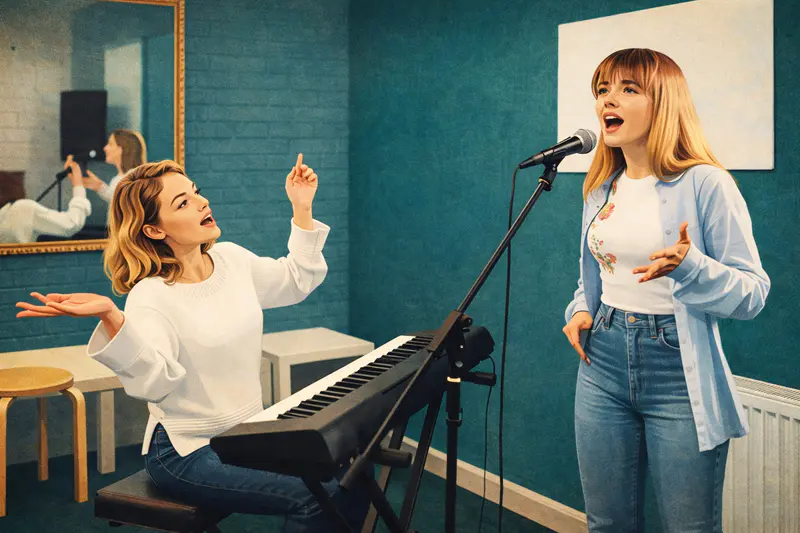
What Are Singing Lessons?
Singing lessons (also called vocal lessons) are recurring sessions with a vocal coach who listens to you sing, diagnoses what is working and what is not, and gives you targeted exercises to improve. Coaches address the physical mechanics of singing, including breath, posture, resonance, and articulation, alongside musical skills like phrasing, dynamics, and interpretation. Most lessons also include repertoire work, where you apply technique to actual songs you want to perform.
The difference between singing lessons and casual practice is external feedback. A coach can hear tension, pitch drift, or breath inefficiency that you may not notice in your own voice. That real-time correction is what accelerates progress.
What Singing Lessons Help With
A good vocal coach addresses both the technical and expressive sides of singing. Common outcomes include:
Pitch accuracy: Training your ear and your vocal coordination so notes land where you intend them.
Breath support: Learning diaphragmatic breathing patterns that sustain longer phrases and give you dynamic control.
Vocal range: Gradually and safely extending the notes you can access without strain.
Tone and resonance: Shaping your sound by adjusting where and how your voice resonates.
Diction and articulation: Making lyrics clear and intentional across genres.
Confidence and stage presence: Performing in front of a coach builds comfort that transfers to audiences.
Stamina: Reducing vocal fatigue through efficient technique, so your voice holds up through a full set or rehearsal.
Progress on any of these depends on consistent practice between sessions. Lessons set the direction; daily work covers the distance.
Singing Lessons for Every Age & Level
Vocal coaching looks different depending on who is in the room. A seven-year-old and a forty-year-old adult bring different physical development, attention spans, and goals to a lesson.
Kids (roughly ages 5 to 12): Lessons tend to be shorter (often 30 minutes), game-based, and focused on healthy habits like posture, breathing, and pitch matching. A qualified coach will avoid pushing young voices into volume or range extremes. Professional organizations in voice pedagogy have published guidance on age-appropriate teaching practices and ethical standards for working with children.
Teens (roughly ages 13 to 18): Adolescent voices are changing, sometimes unpredictably. Coaches who work with teens understand how to build technique around a voice that is still developing, and they often incorporate repertoire from genres the student actually listens to. Performance prep for school musicals, auditions, or competitions is common at this stage.
Adults, beginners: Many adults start singing lessons believing they "can't sing." In practice, pitch, rhythm, and breath coordination are trainable skills. A beginner-friendly coach will start with fundamentals and build from there without judgment.
Adults, intermediate to advanced: Experienced singers typically seek coaching for specific goals: expanding range, switching genres, preparing for recording sessions, or fixing habits that cause strain. Lessons at this level involve more nuanced feedback on tone, phrasing, and performance interpretation.
What Happens in a Typical Singing Lesson
Most singing lessons follow a predictable structure, even if the specific exercises vary by coach and student. A typical flow looks like this:
Check-in: The coach asks how your week of practice went, what felt good, and what felt difficult.
Warmups: Vocal exercises that wake up the voice and reinforce technique. Many coaches use semi-occluded vocal tract (SOVT) exercises like humming, lip trills, or straw phonation, where you sing through a straw to build efficient airflow with less vocal effort.
Technique focus: One or two targeted drills addressing a current priority (breath support, vowel placement, register transitions, etc.).
Song work: Applying the day's technique to a piece of repertoire. The coach listens, stops to correct, and has you repeat sections.
Practice plan: A brief recap of what to work on before the next session, including specific exercises and song sections.
The balance between these blocks shifts depending on lesson length.
Example 30-Minute Lesson
Thirty-minute lessons work well for kids and for adult beginners who want a focused, frequent touchpoint.
Example 45-Minute Lesson
Forty-five minutes gives room for more repetitions and a second technique drill. Feedback loops get tighter because the coach can revisit a problem area after working on a song.
Example 60-Minute Lesson
An hour-long lesson supports deeper technique work, performance simulation, and more detailed planning. This format is common for intermediate and advanced singers.
Private vs Group Singing Lessons
Private singing lessons give you undivided attention, a pace set entirely by your needs, and immediate correction. Group lessons cost less per session and add a social element that some learners find motivating, especially kids and teens. The tradeoff is straightforward: private lessons accelerate individual technique; group lessons build comfort singing around others.
A practical approach for many singers: start with private lessons to build a technical foundation, then add group sessions or performance workshops for stage experience. For a deeper comparison, see Private vs Group Lessons: Which Learning Style Fits You?
Online vs In-Person Singing Lessons
Online singing lessons work well for technique coaching, ear training, and guided practice. A coach can hear your pitch, tone, and breath patterns clearly enough through a decent audio setup to give actionable feedback. In-person lessons add the ability to monitor posture and physical tension more closely, and they remove any audio latency from the equation.
The most significant limitation of online lessons is latency: the slight delay in audio transmission over video calls. Latency makes it impractical for a coach and student to sing simultaneously in sync. The workaround is simple. Play any backing track or metronome locally on your end so the combined sound of your voice and the accompaniment reaches the coach together.
Online Lesson Checklist
Before your first online vocal lesson, set yourself up for clear audio and minimal distractions:
Choose a quiet room with minimal echo (carpeted rooms or spaces with soft furnishings work best).
Use headphones to reduce feedback and echo on the call.
Position your camera at eye level with good lighting so the coach can see your posture and jaw.
Use a stable internet connection; wired is more reliable than Wi-Fi if available.
Enable "original sound" or music mode in your video platform's settings, if the option exists, to prevent auto-compression of your voice.
Keep a water bottle, your sheet music or lyrics, and any backing tracks accessible on your device.
Play accompaniment or metronome locally rather than expecting real-time duets with the coach.
How to Choose a Singing Coach
The right coach is someone whose teaching style, genre expertise, and communication approach match your goals. A classically trained soprano and a pop belter may both be excellent teachers, but their default frameworks will differ. Fit matters more than credentials alone.
Professional voice pedagogy has established norms around ethics, age-appropriate instruction, and evidence-based technique. When evaluating a coach, consider:
Genre alignment: Do they have experience teaching in the style you want to sing (pop, classical, R&B, musical theater, etc.)?
Goal fit: Are they comfortable with your specific objectives, whether that is audition prep, hobby singing, or vocal rehabilitation?
Teaching style: Do they explain concepts in a way that makes sense to you? Some coaches are more analytical; others are more intuitive.
Experience with your age group: Especially relevant for kids and teens, where vocal development requires a careful approach.
Communication and safety: Do they create an environment where you feel comfortable making mistakes and asking questions?
Questions to Ask Before Booking
A short conversation (or message exchange) before your first lesson can save time for both of you:
What is your approach to teaching beginners (or advanced singers)?
How do you structure lessons and track progress over time?
Will you provide a practice plan between sessions?
How do you handle feedback? (Some students prefer direct correction; others prefer encouragement-first approaches.)
Do you have experience with my genre or performance goals?
What does a typical first lesson look like?
How Much Do Singing Lessons Cost?
Singing lesson pricing varies based on several factors, and quoting a single number would be misleading. The main cost drivers are:
Lesson length: 30-minute sessions cost less than 60-minute sessions with the same coach.
Coach experience and credentials: A coach with decades of teaching and performance experience will typically charge more than someone early in their career.
Location: Rates in major metro areas tend to be higher than in smaller cities or rural areas.
Format: Online lessons sometimes cost less because the coach has no studio overhead, though pricing increasingly overlaps with in-person rates.
Package vs single session: Many coaches offer discounted rates when you book a package of multiple lessons upfront.
When comparing prices, weigh the total value: a slightly more expensive coach who gives you a structured practice plan and clear progress benchmarks may deliver faster improvement than a cheaper option without those elements.
Also Learning an Instrument? Voice + Guitar
If you are interested in songwriting or performing as a singer-songwriter, pairing voice lessons with guitar lessons is a practical combination. Guitar provides harmonic context for your singing. You learn how chords support melody, how rhythm interacts with phrasing, and how to accompany yourself without relying on a backing track.
The two skills reinforce each other. Singing while playing guitar trains coordination, timing, and musical independence. Many coaches on TeachMe.To teach both instruments, which can simplify scheduling and keep your musical development aligned.
Singing vs Guitar: What Practice Looks Like
Practice expectations differ between voice and guitar, and neither is inherently "easier" than the other.
Both benefit from short, consistent daily sessions over occasional long ones. If you are studying both, alternating focus days (voice Monday, guitar Tuesday) can help manage practice time without burnout.
Get Started with TeachMe.To
TeachMe.To connects you with singing coaches for private lessons, either online or in your area. The booking process works in three steps:
Browse and filter. Search coaches by singing style, lesson format (online or in-person), availability, and price. Watch intro videos to get a sense of each coach's personality and approach.
Book a lesson. Pick a time that works for you and book directly through the platform.
Connect and start. Message your coach before the lesson to share your goals, then meet for your first session.
Filters for location, genre, and scheduling make it straightforward to find a coach who fits your specific situation. Browse singing coaches now.