Most parents searching for football training for kids eventually land on the same three options: hire a private football coach, sign up for a camp, or register for a youth league or clinic. Each one trains different things, costs different amounts, and fits different stages of a young athlete's development. The right answer depends on your kid's age, goals, and what they actually need right now, not what looks best on a brochure.
This guide gives you a framework for choosing, plus honest tradeoffs for each path.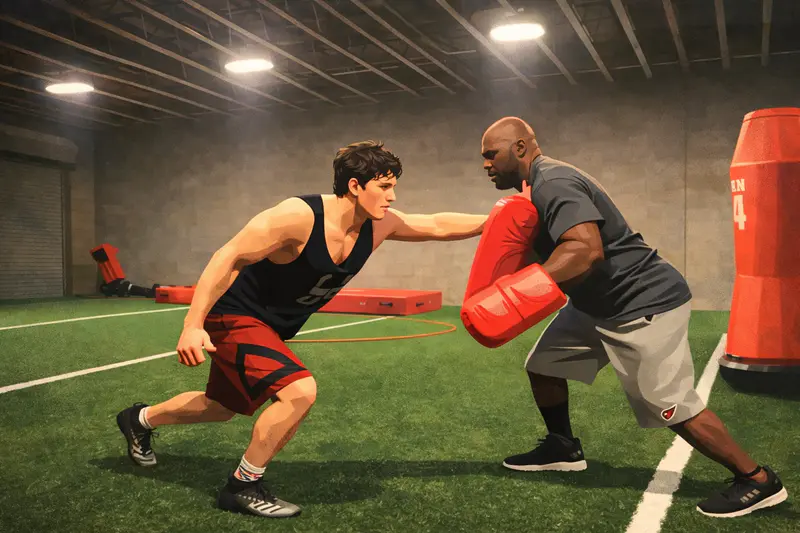
TL;DR: Which Option Fits Which Kid?
Quick rule of thumb: Leagues teach kids to play football. Camps compress a lot of reps into a short window. Private coaching isolates and fixes the specific things holding a player back.
The Decision Framework (Start Here)
The choice between a private football coach, a camp, and a league is not "which is best." It is "which solves the problem in front of you." Start with your child's goal, then match the format to that goal based on their age.
Choose by Age
Youth (ages 4-10). The priority is fun, basic movement skills, and learning to love the game. Most kids at this stage benefit most from a recreational league or flag football training program. Position specialization is premature. Structured competition teaches rules and social skills that no amount of private reps can replicate.
Middle school (ages 11-14). Athletes start developing a position identity and building sport-specific athleticism. A combination of league play and targeted private coaching or a camp often works well. A football conditioning program becomes relevant as bodies change.
High school (ages 15-18). Skill refinement, position mastery, and recruiting exposure take center stage. Private coaching and specialized camps become higher-ROI investments because the athlete is mature enough to absorb detailed technical feedback. League play (school teams, club ball) is typically a given at this age.
Choose by Goal
Skill development. A private football coach offers the most correction per minute. Camps offer high-volume reps in a focused window.
Conditioning. Camps and leagues both build sport-specific fitness through volume. A dedicated football conditioning program with a trainer is the most targeted route for serious athletes.
Confidence. Younger or less experienced players often gain confidence fastest in low-pressure settings: recreational flag leagues (like i9 Sports) or one-on-one sessions where mistakes are private.
Exposure and recruiting. Prospect camps run by college programs and nationally recognized camps put athletes in front of evaluators. Private coaching helps athletes prepare for those moments, but the showcase events themselves provide the exposure.
Private 1:1 Football Coaching
A private football coach works with your child individually (or in very small groups) on position-specific skills, mechanics, and football IQ. Sessions are typically 45 to 90 minutes. The value is precision: a good coach identifies exactly what a player needs to fix and drills it repeatedly with real-time feedback.
Best For
Athletes with a specific mechanical issue (throwing motion, route running, pass rush technique)
Players preparing for tryouts, combines, or a position switch
Kids who are shy, new to football, or need confidence before joining a team
High school players working with a quarterback coach, wide receiver trainer, or defensive back specialist to refine position skills
Off-season football training when there is no league or team practice available
What a Good Session Looks Like
A well-run private session follows a predictable structure. Expect a dynamic warm-up (5-10 minutes), a focused skill block targeting one or two specific techniques (25-40 minutes), and a cool-down with feedback and homework for the week.
The best coaches film portions of the session and use video to show the athlete what they are doing versus what they should be doing. They also communicate with parents after each session about progress and next steps.
Look for a coach who asks your child questions rather than just giving commands. Athletes who understand why they are drilling a movement retain it better during games.
Pros and Cons
Pros:
Customized to your child's gaps. Every minute targets what your kid specifically needs, not a generic drill rotation.
Flexible scheduling year-round. Sessions fit around school, league play, and family life, making it ideal for off-season football training or in-season tune-ups.
Fastest mechanic correction per hour. A quarterback coach can rebuild a throwing motion in weeks rather than months when working one-on-one.
Low-pressure environment. Mistakes happen without peer judgment, which is valuable for younger or less confident players.
Cons:
No game-speed context. Drills in a controlled setting do not replicate the chaos of a real play with defenders closing in.
Higher per-session cost. One-on-one instruction is the most expensive format per hour (more on football training cost below).
Quality varies widely. The private coaching market is unregulated, so vetting credentials and references matters more than in organized programs.
Platforms like TeachMe.To can help you find and compare private football coaches in your area, with profiles that list experience, specializations, and reviews.
Football Camps
Football camps come in several formats: local day camps, overnight residential camps, position-specific clinics, and college prospect/exposure camps. The common thread is immersion. Athletes get concentrated reps over a short period, typically alongside peers of similar age and skill.
Best For
Athletes who want to pressure-test their skills against new competition
Families looking for a productive one-week block during off-season or summer
Players exploring whether they want to specialize at a position
High schoolers seeking recruiting exposure at college-run camps
Kids who respond well to new environments and coaching voices
What Camps Typically Include
If you are researching how to choose a football camp, look for programs that publish a clear daily schedule, coaching staff bios, and a breakdown of what each day covers. IMG Academy's football camp page, for example, organizes information into training schedule, coaching credentials, specialization tracks, facilities, and campus life details. That structure is a useful template for evaluating any camp.
A solid camp experience usually covers:
Position-specific drill work (quarterback, receiver, lineman, defensive back sessions)
Team and 7-on-7 periods for game-context application
Strength, speed, and agility training as part of a broader football conditioning program
Film review or classroom sessions at more advanced levels
Supervision and structured downtime for overnight programs
Cost and Logistics
Camp pricing varies dramatically based on format, location, duration, and facilities. Day camps run by local coaches or organizations sit at the lower end. Overnight destination camps with professional-grade facilities sit at the top.
As a reference point, IMG Academy's football camp starts at $1,539 for athletes ages 10-18. That represents the premium end of the market. Local day camps and youth football clinics typically cost a fraction of that amount, though pricing depends on region, camp length, and coaching staff.
The main cost drivers: overnight vs. day format, travel and lodging, coach-to-athlete ratio, facility quality, and whether the camp includes extras like film review or performance testing.
Youth Leagues and Clinics
Youth football leagues optimize for something camps and private coaching cannot replicate: consistent, weekly game reps in a team context. Kids learn the rules, develop football IQ, and build the social and emotional skills that come from being part of a team over a full season.
Youth football clinics are shorter-term introductions (often 4-6 weeks) that teach fundamentals without a full season commitment. They serve as a good entry point for families testing whether their child enjoys the sport.
Best For
First-time players who need to learn how football actually works
Kids who thrive on social connection and team identity
Athletes who need game reps to apply what they have learned in private coaching or camps
Families looking for an affordable, structured weekly commitment
Flag vs. Tackle Considerations
Flag football training has grown significantly as a standalone pathway, not just a stepping stone to tackle. NFL FLAG serves over half a million kids across more than 1,600 local leagues, positioning flag as a legitimate competitive option.
For younger athletes (roughly ages 4-10), flag football builds core skills like route running, throwing, catching, and spatial awareness without contact. Programs like i9 Sports offer flag football leagues for kids ages 4-14 with an inclusion-first approach where every child plays every game.
The flag-to-tackle transition is a family decision shaped by the child's physical readiness, interest level, and comfort with contact. Many families use flag through elementary school and introduce tackle in middle school, but there is no single "right" age.
How to Find a League Near You
Start with NFL Play Football's league finder. Enter your ZIP code to see NFL FLAG leagues and Pop Warner programs in your area.
Check USA Football's league finder for additional options not listed on the NFL site.
Contact your school district or local parks and recreation department. Many youth football leagues operate through municipal recreation programs.
Ask other parents. Word of mouth remains the most reliable way to learn which local leagues are well-run and which to avoid.
Position-Specific Needs (QB, WR/TE, OL/DL, DB/LB)
Football position training becomes relevant once a player has a general skill foundation and a clear position trajectory. For most athletes, that is middle school at the earliest.
Quarterback. A dedicated quarterback coach is the most common position-specific investment parents make. Throwing mechanics, footwork, pocket presence, and reading defenses all benefit significantly from one-on-one work. Camps with QB-specific tracks are also valuable for high-volume throwing reps.
Wide receiver and tight end. Wide receiver training focuses on route running precision, release techniques, and catching mechanics. These skills translate well from one-on-one coaching because they are highly repetitive and technique-driven.
Offensive and defensive line. Lineman training is underserved in the private coaching market, but it is arguably where athletes gain the most from individualized attention. Hand placement, leverage, footwork patterns, and pad level are technical skills that benefit from patient, rep-heavy coaching.
Defensive back and linebacker. Defensive back training covers backpedal mechanics, hip turns, ball-tracking, and zone/man coverage technique. Linebackers need similar footwork along with blitz timing and run-fit discipline. Both positions benefit from both private reps and camp settings where they can work against live receivers.
For any position, the best investment sequence is: learn fundamentals through a league, identify position-specific gaps, then use a private coach or specialized camp to address those gaps.
Safety and Vetting Checklist
Before committing to any coach, camp, or league, run through this checklist:
Coaching credentials. Does the coach hold a USA Football certification, have playing experience at the college or professional level, or have verifiable coaching references?
Background check. Has the organization or coach completed a background check? Reputable leagues and camps require them.
Contact policies. Are there clear rules about adult-to-child ratios, one-on-one supervision, and communication boundaries?
Medical preparedness. Is there an athletic trainer or certified first-aid provider on-site during practices, games, and camp sessions?
Heat and hydration protocols. Does the program have a written policy for water breaks, heat index thresholds, and practice modification in extreme weather?
Concussion policy. Does the league or camp follow a return-to-play protocol consistent with current guidelines?
Parent access. Can you observe practices and sessions? Programs that restrict parent visibility without a clear, reasonable explanation warrant caution.
Insurance. Does the program carry liability insurance?
Trust your instincts. A program that is evasive about any of these items is not worth the risk, regardless of reputation.
Typical Costs (What Drives Price)
Football training cost varies by format, region, coach experience, and program quality. Rather than quoting precise numbers that shift by market, here are the general bands and what moves the price within each.
The single biggest cost driver across all formats is the coach-to-athlete ratio. Smaller groups and one-on-one work cost more per hour but deliver more individualized feedback per rep.
Recommended Paths (Common Combinations)
Most families get the best results by combining formats rather than choosing just one. Here are three age-based bundles that balance skill development, game experience, and budget.
Path 1: Youth Player (ages 5-10) Start with a recreational flag football league (like i9 Sports or NFL FLAG) for game reps, rules, and fun. Add a short local clinic during the off-season if the child wants more. Private coaching at this age is usually only needed if the child has a specific confidence issue or wants targeted help with throwing or catching.
Path 2: Middle School Player (ages 11-14) Play in an organized league (flag or tackle, based on family preference). Layer in a week-long camp during the summer to experience new coaching and competition. Begin working with a private football coach on position-specific skills once the athlete has identified a primary position.
Path 3: High School Player (ages 15-18) School ball or club competition is the foundation. Use a private coach or position specialist (quarterback coach, defensive back trainer, etc.) for weekly or biweekly sessions during the off-season. Attend one or two exposure/prospect camps per year for recruiting visibility. A structured football conditioning program rounds out the package.
Next Step: Your 3-Step Plan
1. Define the goal. Write down, in one sentence, what you want your child to get out of football training right now. "Learn the basics and have fun" leads to a very different choice than "improve his 40 time and get seen by college scouts."
2. Shortlist options. Based on the framework above, identify one option in each relevant category (a league, a camp, or a coach). For leagues, start with the NFL Play Football league finder. For private coaches, browse profiles on platforms like TeachMe.To. For camps, check local programs and national options that match your child's age and position interests.
3. Run a trial. Before committing to a full season or a long coaching engagement, try a single session, a short clinic, or a one-week camp. Watch how your child responds to the coaching style, the environment, and the other athletes. The best training program is the one your kid actually wants to show up to.