
Piano lessons open the door to one of the most rewarding skills you can develop at any age. Whether you're a parent researching piano classes for your child, an adult picking up the instrument for the first time, or a returning player looking for a new piano teacher, this guide covers everything: costs, formats, how to choose the right instructor, and what to expect from your first lesson. TeachMe.To makes it simple to find and book qualified local piano teachers who match your goals, schedule, and budget.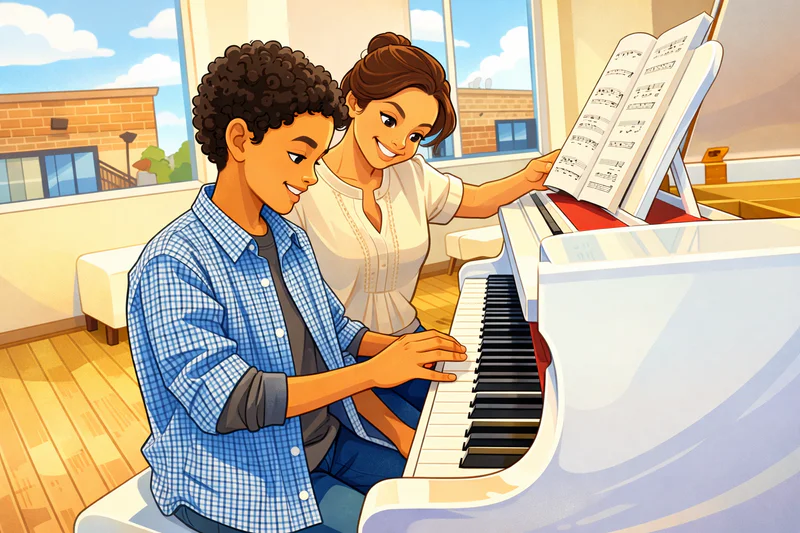
Find a Piano Coach Near You
Ready to get started? Browse local piano coaches and book your first lesson.
Why Piano Lessons Are Worth the Investment
You already know piano sounds beautiful. But the reasons to learn piano go far beyond music. The instrument builds skills that transfer into academics, mental health, career readiness, and everyday problem-solving. It's not a luxury hobby. It's a practical investment in your brain.
Cognitive and Mental Health Benefits
A 2023 study published in the Journal of the American Medical Association found that musical training (particularly piano) was associated with improved memory, processing speed, and executive function in both children and older adults. Piano requires simultaneous use of both hands, reading two clefs, listening, and adjusting in real time. That kind of multi-tasking strengthens neural pathways in ways few other activities can match.
For adults, regular piano practice has been linked to reduced anxiety and lower cortisol levels. For kids between ages 5 and 9, structured piano instruction improves working memory and attention span more effectively than other extracurricular activities.
"Piano is the one instrument where you're a full orchestra. You play melody, harmony, bass, and rhythm simultaneously. That's why the cognitive benefits are so pronounced."
Long-term Musical and Career Advantages
Piano serves as the foundation for virtually every other area of music. If you learn piano first, picking up guitar, drums, or even music production software becomes significantly easier. You'll understand chord structures, key signatures, and rhythmic patterns at a deeper level than someone who starts on a single-note instrument.
Beyond performance, piano fluency opens paths to music education, composition, worship music leadership, studio session work, and music therapy (a field projected to grow 15% through 2032, according to the Bureau of Labor Statistics).
Types of Piano Lessons: Finding Your Perfect Learning Style
Not all piano lessons look the same. The format you choose affects how quickly you progress, how much you spend, and how much you enjoy the process. Here's a direct comparison:
Private In-Person Piano Lessons
This is the gold standard. A piano teacher sitting next to you can correct your hand position in real time, demonstrate touch and dynamics on the same instrument, and read your body language to gauge frustration or confusion. Private piano lessons typically run 30 minutes for young beginners and 45 to 60 minutes for teens and adults.
The biggest advantage? Accountability. Your teacher tracks your progress week to week and adjusts the curriculum to your strengths and weaknesses. As we've covered in our guide on the power of one-on-one coaching, personalized attention is the single fastest path to skill development.
Online Piano Lessons and Virtual Instruction
Online piano lessons have improved dramatically. With a decent webcam and a keyboard positioned correctly, a qualified teacher can assess your technique, assign repertoire, and provide real-time feedback through video. Platforms like TeachMe.To connect you with vetted instructors who teach online, so you're not rolling the dice on a random Zoom link.
The trade-off: your teacher can't physically adjust your wrist angle or demonstrate side-by-side on the same piano. For intermediate and advanced players, this matters less. For absolute beginners, at least a few in-person sessions up front can prevent bad habits from forming.
Group Piano Classes vs Individual Instruction
Group piano classes work well for young children (ages 4–6) who benefit from peer motivation, and for adults who want a low-pressure social environment. You'll pay less per session, but the instruction won't be tailored to your specific challenges. If you're unsure which format suits you, our breakdown of group vs. private coaching walks through the decision in detail.
Piano Lessons by Age Group: What Works Best for Different Life Stages
Children's Piano Lessons (Ages 4–12)
What age should a child start piano lessons? Most piano teachers recommend age 5 or 6 as the sweet spot. At this age, a child's hands are large enough to reach five adjacent keys, their attention span supports 20 to 30 minute lessons, and they can begin recognizing basic notation.
For children under 5, pre-piano classes (rhythm games, singing, and basic keyboard exploration) build a musical foundation without the pressure of formal instruction. Parent involvement matters enormously at this stage. Sitting in on lessons, supervising daily practice of just 10 to 15 minutes, and celebrating small wins keeps momentum going.
Teen Piano Lessons (Ages 13–17)
Teenagers learn piano faster than younger children because their abstract thinking and fine motor skills are more developed. The challenge is motivation. A good piano teacher for teens incorporates music the student actually likes (pop, film scores, video game soundtracks) alongside classical technique.
For college-bound students, piano proficiency can support music scholarship applications or strengthen an overall arts portfolio. Even for teens not pursuing music academically, the discipline of weekly lessons and daily practice demonstrates commitment that college admissions officers notice.
Adult Piano Lessons and Late Starters
Here's the truth: adults learn piano differently than kids, but not worse. You understand theory concepts faster, you're more disciplined about practice, and you have clearer goals. A 2019 study from the University of South Florida found that adults who took piano lessons for just 16 weeks showed measurable improvements in cognitive processing and memory.
The biggest barrier for adults isn't talent. It's time. If you're juggling a career and family, our time management tips for adult learners can help you carve out consistent practice windows without overhauling your schedule.
"I started piano at 42. I'll never play Carnegie Hall. But I can sit down and play songs that move people, and that's enough." — TeachMe.To student review
How to Choose the Right Piano Teacher
Finding the right piano teacher is the single most important decision you'll make. A mismatched instructor can kill your motivation in weeks.
Essential Qualifications and Teaching Experience
Look for these credentials:
A degree in music performance or music education (or equivalent professional experience)
At least 3 years of teaching experience with students at your level
Familiarity with multiple methods (Faber, Alfred, Suzuki, Royal Conservatory)
Positive reviews from students with similar goals to yours
A concert-level pianist isn't automatically a great teacher. Teaching requires patience, communication skills, and the ability to break complex movements into simple steps. Ask how they handle students who get stuck. Their answer reveals more than their résumé does.
Teaching Style and Personality Fit
Request a trial lesson before committing. During that first session, pay attention to whether the teacher:
Explains concepts clearly and checks your understanding
Adjusts their approach when something isn't clicking
Makes you feel encouraged rather than criticized
Asks about your musical interests and goals
TeachMe.To profiles include student reviews, teaching specialties, and instructor bios that help you narrow your search before you ever book a trial. It's like reading restaurant reviews before making a reservation; you walk in with confidence instead of guessing.
Piano Lesson Costs: What to Expect and How to Budget
Factors That Influence Piano Lesson Pricing
Piano lesson costs vary based on several factors:
Don't forget hidden costs: method books ($10–$30 each), recital fees ($15–$50 per event), and eventually, a quality instrument at home. A basic digital keyboard suitable for beginners runs $150 to $400.
Getting the Best Value for Your Piano Lesson Investment
Package deals (buying 4 or 8 lessons at once) typically save 10% to 15%. Many teachers on TeachMe.To offer introductory rates or discounted bundles for new students.
But the real value question isn't "what's cheapest?" It's "what gets me to my goal fastest?" A $90/hour teacher who identifies and fixes your weak spots in four lessons saves you more money than a $40/hour teacher who takes twelve lessons to cover the same ground. Think of it the same way we explain the value of coaching investments across all sports.
What to Expect in Your First Piano Lessons
First Lesson Structure and Assessment
Your first piano lesson is part conversation, part evaluation, part hands-on playing. Expect your teacher to:
Ask about your musical background, favorite genres, and goals
Assess your current skill level (even if it's zero)
Evaluate your hand size, posture, and natural coordination
Introduce basic keyboard geography (finding Middle C, understanding groups of two and three black keys)
Set short-term goals for the next 4 to 6 weeks
Come prepared to answer: "What do you want to be able to play in six months?" That answer shapes everything.
Essential Skills and Concepts in Early Lessons
Your first few weeks will cover:
Proper seated posture and hand position (curved fingers, relaxed wrists)
Reading treble clef notes (right hand) and eventually bass clef (left hand)
Basic rhythm counting (quarter notes, half notes, whole notes)
Simple melodies using five-finger position
Most students can play a recognizable song within 2 to 4 weeks. Within 3 to 6 months of consistent weekly lessons and daily practice, you'll handle simple pieces with both hands together.
Piano Lessons vs Self-Teaching: Making the Right Choice
When Self-Teaching Works Best
Self-teaching works if you're naturally disciplined, have a strong ear, and your goal is casual playing for personal enjoyment. Apps like Simply Piano or Flowkey provide structured curricula at low cost. YouTube tutorials are free and abundant.
The risk? Without a teacher, you won't know what you don't know. Bad hand habits compound over months and become painful to unlearn later.
Why Professional Instruction Accelerates Progress
A 2020 survey by the Music Teachers National Association found that students who took weekly lessons with a qualified teacher progressed 3 to 5 times faster than self-taught learners over a 12-month period. The difference comes down to real-time error correction, structured skill progression, and the accountability of showing up each week. As we've explored in our piece on how coaches help learners overcome plateaus, having an expert eye on your technique is often the difference between stalling out and breaking through.
How TeachMe.To Revolutionizes Piano Lesson Discovery
Verified Teacher Profiles and Student Reviews
TeachMe.To takes the guesswork out of finding a piano teacher. Every instructor on the platform has a detailed profile showing their qualifications, teaching specialties, years of experience, and honest student reviews. You can filter by lesson type (in-person or online), skill level, musical genre focus, and price range.
No more cold-calling studios or hoping a Craigslist ad leads to someone competent.
Flexible Scheduling and Lesson Management
Book your lessons directly through the platform, manage your schedule, and communicate with your teacher in one place. If you need to reschedule, the system handles it without awkward text chains. For parents managing kids' piano classes alongside other activities, this alone saves hours of coordination each month.
TeachMe.To connects you with qualified, reviewed piano teachers in your area (or online) and lets you book lessons in under two minutes.
Getting Started: Your Next Steps to Piano Success
You've read the research, you understand the costs, and you know what to look for in a teacher. The only thing left is to actually start. Every week you wait is a week of progress you don't get back.
Here's your action plan:
Decide your format: in-person, online, or a hybrid approach
Set a realistic budget: factor in lessons, books, and a practice instrument
Browse qualified teachers on TeachMe.To: filter by location, price, specialty, and reviews
Book a trial lesson: assess the fit before committing long-term
Practice consistently: even 15 minutes a day beats an hour once a week
Piano lessons are one of the few investments that pay dividends for the rest of your life. Whether you're 6 or 60, the best time to start was yesterday. The second best time is right now. Head to TeachMe.To and find the piano teacher who'll help you play the music you've always wanted to hear from your own hands.