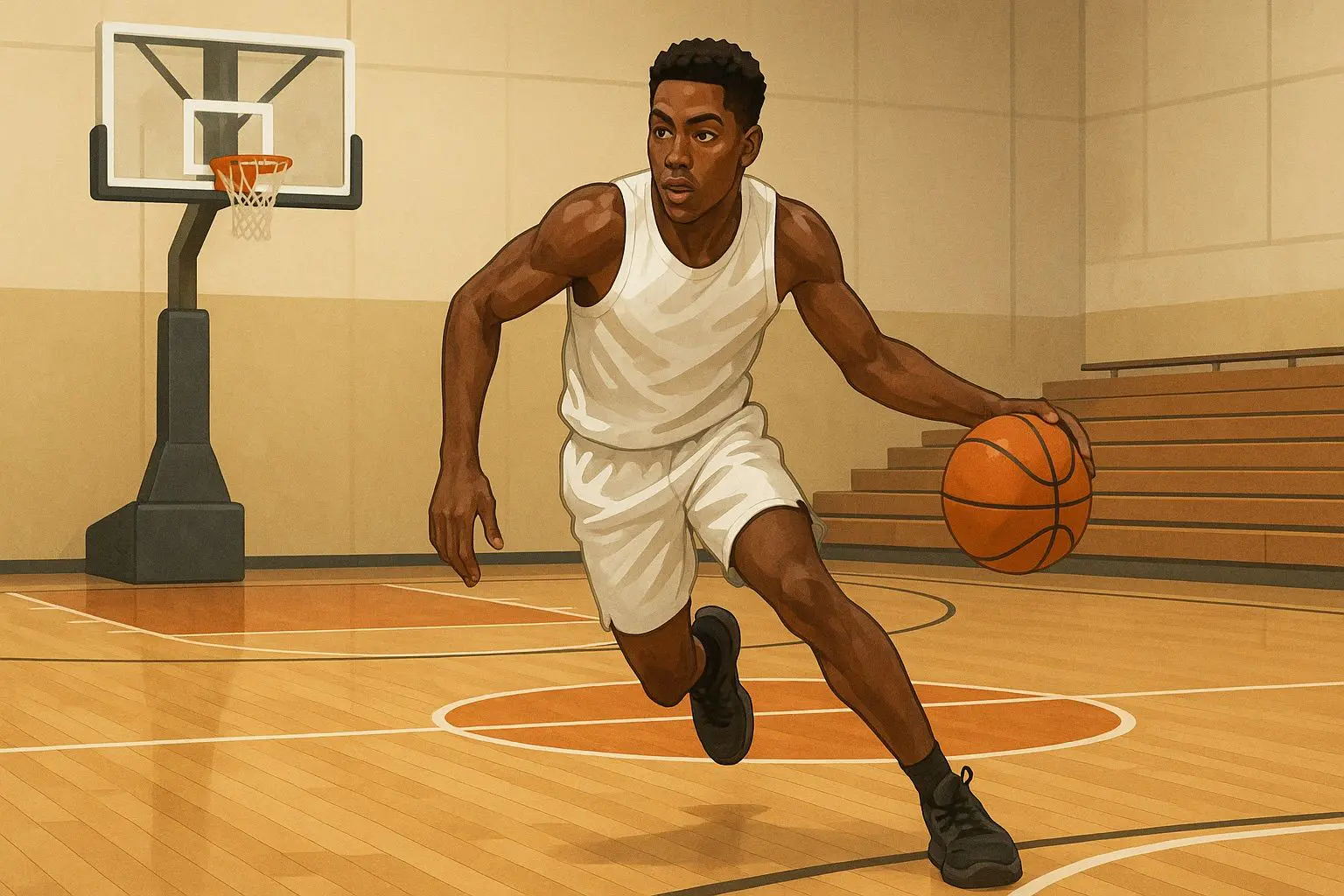
Driving to the hoop is one of the most exciting moves in basketball. Whether you’re playing pickup at the park or running a play in an organized game, there’s nothing quite like blowing by your defender and scoring at the rim. Not only does a successful drive get the crowd hyped, it often leads to free throws. Just picture LeBron James barreling down the lane like a freight train, or Kyrie Irving slicing through traffic with a crafty layup off the glass. These pros make it look easy, but fear not: with the right tips on footwork, timing, body control, and savvy decision-making, you can dramatically improve your drives to the basket, too.
1. Quick First Step and Killer Footwork
The foundation of any good drive is a quick first step and solid footwork. That initial burst is how you get a step ahead of your defender. “You don’t have to be the biggest or fastest, look at Luka, but you do need to know how to read your defender’s feet,” one coach notes. NBA players like Kyrie Irving or Jalen Brunson aren’t blowing by defenders simply with pure speed; they use crafty footwork and fakes to gain an advantage.
Attack the defender’s lead foot
If your defender is leaning or has one foot forward, take advantage of it. For example, if they’re forcing you one way, you can jab step right and then explode left past that top foot. The moment you get your foot outside of theirs, you’ve basically won the foot race to the rim. As legendary trainer Jeff Huber explains, “As soon as that happens, it’s game over”, you’ve got the step on them.
Stay low and balanced
Start from a good triple-threat stance so you can explode in either direction. If you’re too upright, you’ll be slower on that first step. Watch players like Ja Morant, even though he’s super athletic, he often begins drives low to the ground to maximize his explosiveness when he decides to go.
Use jab steps and pump fakes
A quick jab step or a shoulder fake can get your defender off balance or guessing wrong. Kyrie Irving is a master of this; he’ll throw a hard jab step to freeze his man for a split second, then take off in the opposite direction. By the time the defender reacts, Kyrie’s already by him laying it in. Work on your jab step in practice: make it sharp and convincing.
Practice the footwork reads
A great drill for this is to have a friend or coach play dummy defense and give you different stances: one time they angle their body to force you right, next time square up, next time force left. Practice the appropriate move for each situation. Over time, you’ll instinctively recognize how to attack any defender’s stance.

2. Change of Pace and Perfect Timing
Driving to the basket isn’t all about constant full throttle speed, it’s about change of pace. Think of it like a good crossover in music: the change in rhythm is what throws people off. The same goes for your dribble drives.
Vary your speeds
If you’re always going 100% speed, a decent defender will adjust and anticipate your timing. Great slashers like James Harden, Luka Dončić, or Kyrie often start slow, then explode. Try this: approach your defender at a moderate pace, make a move, then go zero-to-sixty in a heartbeat. That sudden burst after a lull is what makes the defender stumble or react late, giving you a clear path.
Be unpredictable
Mix up when you drive. Don’t always go on the first step or first dribble. Sometimes use an extra crossover or an in-and-out dribble before you take off. Other times, just catch and go immediately on the first step. The idea is to keep the defense guessing.
Timing is everything
In organized basketball, timing also means choosing the right moment in the play to drive. If you’re in a half-court set, you might wait until a teammate clears out the lane or until a screen is set. In pickup ball, you might seize the moment when your defender is slightly off balance or not fully ready. A savvy player watches for those moments, maybe your defender just turned their head to look at the ball, or they lunged for a steal and missed. That’s your cue to attack.
3. Body Control and Finishing at the Rim
Okay, so you’ve gotten past your primary defender, great! Now comes the fun part: finishing the drive at the basket. This is where players like Kyrie Irving and Ja Morant really shine, contorting their bodies in mid-air, using clever angles, or absorbing contact to still get the bucket. Let’s break down how you can finish strong once you’re at the rim.
Use your body as a shield
One of the golden rules of finishing layups is to keep your body between the defender and the ball. Watch LeBron James or prime Dwyane Wade, when they go up, their shoulder or chest is into the defender, so the defender can’t actually reach the ball without going through them. This makes your layups way harder to block. Even if you’re not as strong as LeBron, you can still get your body in the way. Drive your shoulder into the defender’s chest as you go up, and extend your arm away from them.
Absorb the contact (within reason)
Driving to the hoop isn’t for the faint of heart, you will get bumped. As LeBron learned, when you “drive to the basket like a freight train,” defenders will try to whack at you or shove you to prevent the layup. The key is to go up strong and expect that contact. If you anticipate a hit, you can better maintain your balance and still get a good shot off. Don’t shy away at the last second or off-balance yourself trying to avoid all contact. Instead, initiate a bit of the contact on your terms: lean in with your off shoulder, absorb the bump, and still focus on the finish. As long as you keep control, you might even get an and-1. And if not, you’re at least likely to get two free throws for your effort.
For you, a practical tip is: aim for the top corners of the backboard square on high layups. By putting the ball up high (above the defender’s reach) and using a soft touch, the ball can drop in even if you’re throwing it way up off the glass. Work on your finger roll and off-the-glass touch in practice. A fun drill is the Mikan Drill: stand right under the hoop, lay it up off the backboard with your right hand, grab it, then lay up with left hand on the other side, alternating back and forth.
Finish with either hand
Speaking of left hand/right hand, you gotta develop your off hand. If you’re a righty, there will be times on a drive when the defense is on your right side, so you must be able to finish lefty. It’s okay if your off-hand layup isn’t as fancy, but you should be comfortable making a basic left-handed layup off your right foot. Practice tons of layups with your weak hand until it’s second nature. In games, try to take what the defense gives: if they’re on your right hip, a lefty finish might be wide open (and vice versa). The best drivers can use both hands around the rim – think of Kyrie or Michael Jordan with those ambidextrous finishes.
4. Reading Defenders and Making Smart Decisions
Driving to the hoop isn’t just a physical skill – it’s a mental one. The best slashers have a sort of on-court IQ about when to drive, when to kick the ball out, and how to read the defense in real time. Let’s talk about understanding both your on-ball defender and any help defenders, so you can make the right play.
Read your on-ball defender’s stance and movements
We touched on this in the footwork section, but it bears repeating: really watch your defender’s body language. Their feet, their weight distribution, their reach, these are clues. If they lean too far one way, hit them with a crossover or quick drive to the opposite side. If you notice they’re playing with their knees locked, attack them.
Also, be aware of reach-ins, if you’re driving against a pesky defender known for stripping the ball, be ready to protect the rock.
Anticipate the help defense
In most cases, beating your man off the dribble is just step one. As one blog quipped, “when you drive to the basket you must normally beat two people. The first is the man guarding you. The second is the big man guarding the basket.” This means: expect someone else (usually a larger defender) to step up and challenge you near the rim. In a pickup game, this might be that tall guy camping in the paint; in an organized game, it’s the opposing team’s center or a weak-side defender sliding over. Keep your head up as you drive. If you see that help defender coming early, you have options: you can dish off to an open teammate.
Know when to go all the way and when to pull up
Part of reading the D is deciding if you should actually go all the way to the rim or stop and pop a short jumper. If the lane looks crowded, it’s perfectly fine to pull up for a midrange shot or a controlled floater. If you see a seam and no one in your way, commit to the drive and don’t second-guess. Nothing worse than beating your man, then hesitating because you’re worried about a shot blocker, and ending up in no-man’s land,
5. Pickup Games vs. Organized Ball – Adjust Your Approach
As promised, let’s talk briefly about how driving in a casual pickup game might differ from driving in an organized, refereed game. The core skills are the same, but the context can change a few things.
In pickup basketball, oftentimes it’s more one-on-one oriented and defense can be a bit laxer (depends on your competition though!). You might have more space to operate since not every team plays help defense rigorously in a casual setting. This can be a great opportunity to practice your drives and be creative. One thing to note in pickup: calling fouls. In many pickup games, there’s an unspoken rule not to call cheap fouls when driving. So when you drive in pickup, expect to get hacked with no whistle. It’s actually a good way to toughen up your finishing ability.
In organized basketball, drives often happen within the team’s offensive scheme. You might drive off a designed play, or you might have to be more aware of help defenders who are well-coached to stop you. The positive side is you have referees, so if you beat your man and a help defender clobbers you, you’ll likely get free throws. Don’t shy from contact just because it’s a real game; in fact, take it strong and force the ref to make a call.
Another aspect of organized play: defenses might try to take charges on your drives. A charge is when a defender steps in front of you and you bowl them over, foul on you, turnover. To avoid charges, learn to jump-stop or euro-step if a help defender is planted in front. A controlled jump-stop can let the defender fly by or allow you to pivot around them for a shot. It also prevents you from crashing full speed into someone. This is more of a concern in competitive games than pickup, where charge calls are rare.
Lastly, organized teams might send multiple defenders, so the drive-and-kick element is bigger. If you’re known as a slasher on your team, be ready for the defense to collapse, which is your chance to be a playmaker. In pickup, you might just beat one guy and score; in organized, beating one guy often means another rotates, so use your IQ to capitalize.
In summary, be fearless but smart in both settings. In pickup, take advantage of the freedom to try things and build your toughness. In organized ball, be efficient and team-oriented – but absolutely use those driving skills to give your team an edge. Coaches love a player who can break down the defense and get high-percentage shots or free throws. It’s a momentum changer.
Stay Confident, Keep Practicing, and Attack the Rim!
Driving to the basket is an art that combines explosiveness, finesse, and basketball IQ. It might seem like a lot to remember, footwork, change of pace, reading help, finishing moves, but these skills will develop with practice and experience. The most important thing is confidence.
Don’t hesitate to seek some guidance if you need it. Sometimes a little coaching can go a long way in improving your technique and boosting your confidence. If you’re looking to level up your game, why not grab a session with a coach who can give you personalized pointers?