Starting your child in football means navigating a maze of options: flag versus tackle, private lessons versus team programs, and safety concerns that keep parents up at night. This guide cuts through the confusion with research-backed recommendations for choosing the right format, finding qualified coaches, and understanding what your young athlete will actually experience on the field.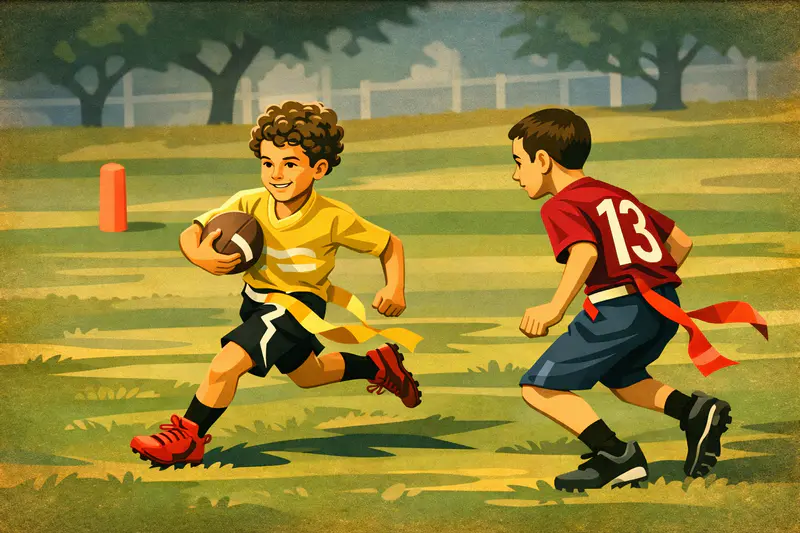
Flag Football vs. Tackle Football: Understanding the Basics
What is Flag Football?
Flag football removes physical contact from the equation. Instead of tackling, defenders pull a flag from the ball carrier's belt to stop the play. Teams typically play 5-on-5 or 7-on-7 formats on smaller fields, emphasizing speed, agility, and quick decision-making over brute force.
The equipment list is refreshingly short: a regulation football, flags attached to a belt, and athletic shoes. No helmets, no pads, no $300 gear investment before your kid even knows if they like the sport.
What is Tackle Football
Tackle football is the traditional 11-player format you see on Sunday afternoons. Players wear full protective gear including helmets, shoulder pads, and padded pants. The game includes specialized positions, blocking schemes, and special teams play that add layers of complexity beyond flag football's streamlined approach.
Physical contact defines every aspect of the game. Players block, tackle, and absorb hits as core elements of play rather than penalties.
Key Differences Between Flag and Tackle
The contact distinction creates cascading differences. Flag football games move faster because there's no pile of bodies to untangle after each play. Smaller team sizes mean more touches per player and less standing around.
Injury risk drops significantly without tackling. The absence of physical contact means fewer concussions, broken bones, and emergency room visits.
Equipment costs tell the story clearly: flag football requires maybe $50 in gear, while tackle football can run $300-500 for a full set of properly fitted protective equipment. Field dimensions shrink in flag football to accommodate smaller teams, making it easier to find practice space.
Which Format is Right for Beginners?
Flag football wins for first-timers. The fundamentals taught in flag—catching, throwing, routes, defensive positioning—transfer directly to tackle when kids are ready. Players learn to read defenses and execute plays without the intimidation factor of getting hit.
Starting with flag lets kids discover whether they actually enjoy football before families invest serious money in tackle gear. The lower time commitment (more on that later) also makes it easier to try alongside other activities.
Age-Appropriate Football Pathways for Kids
Starting with Flag Football (Ages 5-13)
NFL FLAG programs accept children as young as 5 years old, though some families wait until 6 or 7 when kids better understand positional concepts. The beauty of flag football at this age is that it teaches genuine football skills without asking developing bodies to absorb impacts.
Since 2015, participation among 6-to-12-year-olds has surged 38% to over 1.5 million players. Parents are voting with their wallets for a safer entry point.
Transitioning to Tackle Football (Ages 14+)
Medical consensus points to age 14 as the appropriate time to introduce tackle football. The Aspen Institute and Concussion Legacy Foundation both recommend waiting until this age when neck and core muscles have developed enough to better protect the brain during impacts.
Younger players face what researchers call the "bobblehead effect." Their relatively larger heads and weaker neck muscles create more violent head movement during collisions, increasing concussion risk. By 14, most athletes have the physical development to handle contact more safely.
Some families push for earlier starts, but the research doesn't support it. Waiting until high school doesn't handicap athletic development when kids spend their elementary years mastering fundamentals through flag football.
Benefits of Playing Both Formats
Playing both formats creates well-rounded athletes. Flag football develops agility, speed, and precision while tackle teaches blocking, physical toughness, and contact fundamentals. Alternating between them reduces year-round contact exposure while maintaining conditioning.
High school players who compete in tackle during fall can join flag leagues in spring, keeping their skills sharp without accumulating additional hits. This approach addresses growing concerns about cumulative head impacts in youth sports.
What to Expect from Football Training for Kids
Basic Skills Covered in Beginner Programs
Beginner programs focus on foundational movements: proper throwing mechanics, catching with hands rather than body, basic route running, and defensive footwork. Coaches keep drills active and game-like because kids under 10 have short attention spans and learn better through play than lecture.
Expect plenty of repetition on stance and starts, agility work through cones, and passing accuracy drills. Defensive players learn to square their bodies and track ball carriers, developing positioning skills that apply whether they're pulling flags or making tackles later.
Typical Time Commitments
Flag football leagues typically meet once weekly. Teams practice for about 45 minutes before playing a game that lasts an hour or less, totaling roughly two hours per week. This light commitment makes flag football easy to fit alongside school, homework, and other activities.
Tackle football demands significantly more time. Youth tackle programs typically require four two-hour practices weekly plus weekend games, totaling 8-10 hours per week. That's a serious commitment for families with multiple kids or activities.
A useful rule of thumb: children shouldn't play more hours per week than their age in years. A 7-year-old shouldn't exceed seven hours of practice and games combined.
Practice Structure and Guidelines
Youth tackle football operates under strict contact limits. USA Football guidelines recommend no more than 30 minutes of full-contact practice daily and 120 minutes weekly. These limits reduce cumulative head impacts while still teaching proper technique.
Preseason includes a two-week heat acclimatization period where coaches gradually increase practice intensity and equipment worn. This prevents heat-related injuries that historically plagued early-season football.
Football Safety Considerations for Youth Players
Concussion Awareness and Prevention
Modern football has evolved dramatically on safety. Coaches now teach tackling techniques that eliminate head-first contact, a significant departure from old-school methods that put heads in front of ball carriers. Heads-up tackling keeps players safer at every level.
A 2015 JAMA study found concussions occur more often in practice than games, prompting leagues nationwide to limit full-contact practice time. Coaches receive mandatory concussion recognition training, and protocols for handling suspected head injuries have improved dramatically.
Contact limits matter. Youth programs should eliminate high-impact drills that don't replicate game situations, focusing practice contact on teaching proper technique rather than conditioning players to absorb punishment.
Proper Equipment and Helmet Standards
Not all helmets protect equally. Virginia Tech's helmet rating system recommends choosing helmets rated 4 or 5 stars, which correlate with lower concussion risk. All helmets should meet NOCSAE certification standards, which recently updated requirements for youth players to reduce weight and rotational forces.
Guardian Caps offer an additional safety layer. These soft-shell covers fit over helmet hard shells to cushion impacts and reduce concussion risk. Some youth leagues now require them during practice.
Proper fit matters as much as helmet quality. The helmet should sit snugly without excessive movement when players shake their heads. Inspect all protective gear before each practice and game for damage or improper fit.
Coach Safety Training Requirements
Your child's coach should hold current first aid and CPR certification. Verify that an automatic external defibrillator (AED) is available at practices and games. These aren't nice-to-haves—they're essentials that can save lives during cardiac emergencies.
USA Football coaching badges indicate that coaches completed safety-focused training. Ask potential programs whether their coaches hold current certifications and what their concussion protocols look like in practice.
How to Choose a Football Coach or Training Program
Essential Qualifications to Look For
Playing experience provides coaches with firsthand knowledge, but communication, leadership, and organizational skills matter more than whether someone played college ball. The best coaches connect with kids, explain concepts clearly, and create structured practices that maximize learning time.
Look for coaches with relevant certifications. The National Federation of State High School Associations (NFHS) and American Football Coaches Association (AFCA) offer coaching courses that cover both technical skills and age-appropriate teaching methods.
First aid and CPR certification should be non-negotiable. Coaches who invest in safety training signal that they take the responsibility seriously.
Questions to Ask Potential Coaches
Ask about their coaching philosophy. Do they emphasize winning or player development? For youth programs, development should win every time. Players who master fundamentals and love the game at age 10 will outperform kids who burned out chasing championships.
Inquire about safety protocols: What's the concussion policy? How much full-contact practice do tackle programs include? What's the player-to-coach ratio? Smaller ratios mean more individual attention and better supervision during drills.
Ask about their experience with beginners specifically. Coaching experienced players requires different skills than teaching fundamentals to kids who've never held a football.
Red Flags to Avoid
Walk away from programs where coaches lack basic certifications or can't articulate clear safety protocols. If the coach can't explain their concussion policy or contact limits, find another program.
Inadequate or poorly maintained equipment signals deeper problems. Statistics show 62% of sports injuries occur during practice, often because safety standards relax when parents aren't watching.
Excessive emphasis on winning in youth programs creates toxic environments. Kids should compete hard and learn to handle losses, but coaches who berate 8-year-olds for mistakes have lost the plot.
Private Football Lessons: Costs and What to Expect
Average Cost of Private Football Instruction
Private football lessons range from $40-100 per hour nationally, with significant regional variation. Urban areas trend toward the higher end ($75-100), while smaller communities average $40-65 per hour.
Coaches with professional or college playing experience often charge $120-200 per hour for their expertise. That premium buys access to advanced technique coaching and insights from high-level competition.
Group sessions offer budget-friendly alternatives at $30-60 per athlete. Your child gets professional instruction at half the cost of individual lessons, though with less personalized attention.
What Private Lessons Cover
Private instruction provides position-specific technique work unavailable in team settings. Quarterbacks work on throwing mechanics and footwork. Receivers practice route running and catching technique. Defensive backs drill coverage skills and break techniques.
One-on-one attention allows coaches to identify and correct subtle mechanical issues that team coaches miss in group drills. Film review helps players understand what they're doing wrong and visualize improvements.
Finding Qualified Private Instructors
Start by asking your child's team coach for recommendations. They often know quality instructors in the area and can match your child's needs with the right specialist.
Many high school coaches offer private sessions during the off-season. They bring coaching expertise at more affordable rates than former college or pro players. Football camps employ experienced coaches who may be available for private training between camp sessions.
Football Camps and Academies for Beginners
What to Look for in a Football Camp
Quality camps serve ages 7-18 with programming customized for different skill levels. Beginners shouldn't be thrown into drills designed for experienced players. Look for camps that explicitly offer beginner tracks or age-appropriate groupings.
Position-specific instruction matters more than general skills work. Quarterbacks need different coaching than linemen. Camps that provide specialized position coaching deliver better value than one-size-fits-all programs.
For younger players, verify that camps offer non-contact options. Some youth camps focus on skill-building without tackling, making them appropriate for flag football players or kids not ready for contact.
Benefits of Attending Football Camps
Camps provide intensive skill development that's hard to replicate during regular season practices. Players learn proper fundamentals and position techniques through focused repetition with immediate coaching feedback.
Exposure to college and professional coaches opens players' eyes to higher-level football. The experience can inspire kids to take their training more seriously. Beyond athletic skills, camps emphasize teamwork and character development that extends beyond the field.
Top Football Camp Options
IMG Academy in Florida offers year-round programming with customizable schedules for all skill levels. Their facilities and coaching staff represent the gold standard in youth sports training.
Offense-Defense camps operate nationwide, providing professional instruction for beginners through advanced players. NFL teams host youth camps that combine skill instruction with the excitement of training at professional facilities. Position-specific academies focus on quarterbacks, receivers, or defensive backs for players ready to specialize.
Quarterback Training for Beginners
What QB Training Covers
Beginner QB training starts with fundamentals: proper throwing mechanics, footwork, and basic body positioning. Coaches break down the throwing motion into components—grip, stance, release—before building up to full-speed throws.
As players progress, training expands to include pocket movement, coverage recognition, and route timing with receivers. Advanced topics wait until players master the basics. Rushing into complex concepts before fundamentals are solid creates bad habits that take years to fix.
Finding Specialized QB Coaches and Academies
Look for QB-specific camps that allow players to bring their own receivers. Timing and chemistry between quarterbacks and receivers can't develop when QBs only throw to strangers. The best programs accommodate this need.
Judge camp quality by the instructors' backgrounds. Programs taught by coaches with professional or college experience offer insights that high school coaches may lack. Verify credentials rather than trusting marketing claims.
Finding Football Programs Near You
Using League Finders (Pop Warner, NFL FLAG, USA Football)
NFL FLAG operates over 1,600 local leagues serving more than 500,000 kids. Their league finder helps families locate programs nearby, with filters for age groups and skill levels. Pop Warner remains the largest youth tackle program, teaching fundamentals while emphasizing academic success.
USA Football's league finder highlights programs where coaches completed certification training. This distinction matters because certified coaches learn age-appropriate teaching methods and safety protocols that uncertified volunteers may lack.
What to Look for in a Local League
Verify that coaches hold current USA Football training badges. This certification indicates they've completed coursework on proper technique, safety protocols, and child development. Ask about specific safety measures: contact limits during practice, concussion protocols, and equipment standards.
Inspect facilities and equipment before enrolling. Fields should be well-maintained without hazards. Equipment should be properly sized and in good condition. Finding the right program requires homework, but the effort protects your child from poorly run organizations.
Benefits of Flag Football for Children
Physical Development
Flag football improves cardiovascular health through constant movement—running, jumping, quick direction changes, and varied speeds. Practice drills develop speed, agility, and stamina without the injury risks that come with contact football.
The game teaches core football skills: passing, catching, footwork, and defensive positioning. These fundamentals transfer directly to tackle football when kids are ready, meaning flag players aren't starting from scratch if they transition later.
Social and Emotional Growth
Flag football teaches teamwork, cooperation, and understanding different roles within a collective effort. Players learn to trust teammates, communicate effectively, and work toward shared goals. These skills apply far beyond the football field.
The sport builds confidence both on and off the field. Kids learn what being a good sport looks like, how to win and lose gracefully, and how to handle pressure situations. Receiving direction from coaches provides socialization skills that help in school and future workplaces.
Accessibility and Inclusivity
Flag football has no height or weight restrictions, making it a game everybody can play. Co-ed teams are common, giving boys and girls the chance to compete together. This inclusivity stands in contrast to tackle football, where size often determines playing time.
Low equipment costs remove financial barriers. Families need only flags, cones, and a football—maybe $50 total compared to hundreds for tackle gear. This affordability opens the sport to families who couldn't otherwise participate.
Frequently Asked Questions About Beginner Football Training
What age should my child start football?
Flag football is safe starting at age 5, though some kids benefit from waiting until 6 or 7 when they better understand positional concepts and can follow multi-step instructions. Medical consensus recommends waiting until age 14 for tackle football when neck and core muscles have developed enough to better protect against head injuries.
How much do football lessons cost?
Private lessons average $40-100 per hour nationally, with urban areas trending higher and rural areas lower. Group sessions cost $30-60 per athlete, offering professional instruction at roughly half the price of individual lessons. Package deals often save 10-15% compared to booking single sessions.
Is tackle football safe for kids?
Modern tackle football is significantly safer than past decades thanks to improved equipment standards, limited contact during practice, and better coaching on proper technique. When programs follow USA Football guidelines limiting full-contact to 30 minutes daily and 120 minutes weekly, injury risk drops substantially. Waiting until age 14 when bodies are more developed further reduces risk.
Can my child play both flag and tackle?
Playing both formats develops well-rounded skills while reducing year-round contact exposure. Many high school players compete in tackle during fall and join flag leagues in spring, maintaining conditioning and skills without accumulating additional hits. This approach addresses concerns about cumulative head impacts.
How do I find football programs near me?
Use the league finders from NFL FLAG, USA Football, or Pop Warner to locate certified programs in your area. NFL FLAG serves over 500,000 kids through 1,600+ local leagues. USA Football's finder highlights organizations following best practices for child development and safety. Verify coach certifications and safety protocols before enrolling.
Find a Football Coach Near You
Ready to get started? Browse local football coaches and book your first lesson:
Houston · Chicago · Dallas · See all cities →
Conclusion
Choosing the right football pathway for your child comes down to matching their age and development with appropriate formats and qualified instruction. Flag football provides a safe, accessible entry point for kids as young as 5, teaching genuine football skills without contact risks. Tackle football becomes appropriate around age 14 when bodies can better handle impacts.
Prioritize safety by verifying coach certifications, checking equipment standards, and confirming that programs follow contact limits during practice. Whether you choose private lessons, team programs, or camps, quality instruction from coaches who emphasize development over winning sets kids up for long-term success and enjoyment of the sport.
Start by exploring local leagues through NFL FLAG, USA Football, or Pop Warner league finders. Ask the questions outlined in this guide, inspect facilities and equipment, and trust your instincts about whether a program feels right for your family. The time invested in finding the right fit pays dividends in your child's safety, skill development, and love of the game.