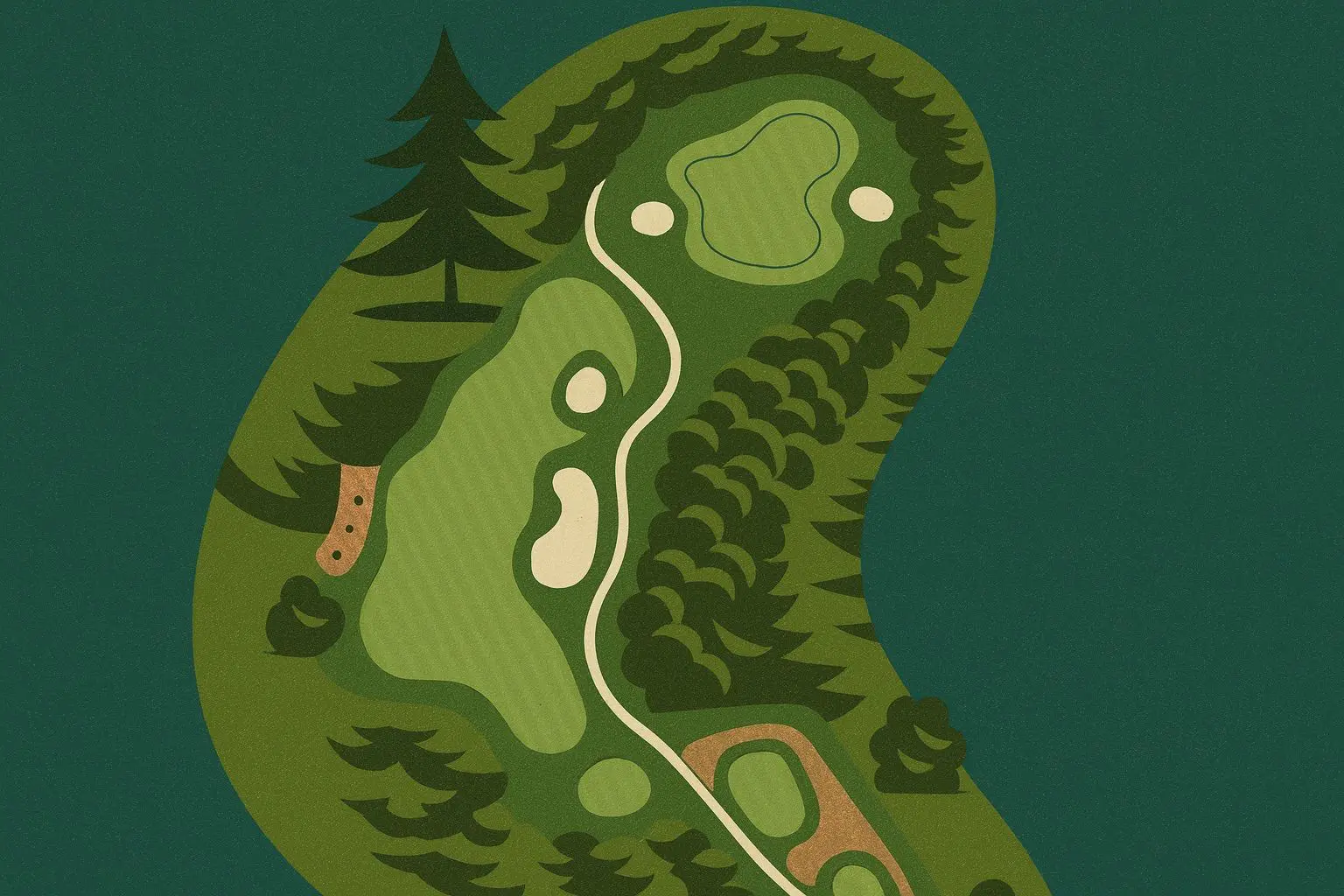
You’re watching golf on a Sunday afternoon, and the announcer says something like, “He’s got a tough lie in the deep rough, trying to get it onto the elevated green, but he has to carry that greenside bunker.” To a new player, that might sound like a different language. To a casual golfer, you probably get the gist, but you might not appreciate the strategy that goes into every single shot.
A golf hole is much more than just a starting point and a finishing point. It’s a landscape designed with purpose, full of challenges and opportunities that force you to think. Understanding its basic anatomy—the tee box, fairway, rough, and green—is the first step to moving beyond just hitting the ball and starting to play golf.
In this guide, we’ll break down the parts of a golf hole in a way that’s simple, strategic, and will help you see your local course in a whole new light.
The Starting Line: The Tee Box
The tee box (or “teeing ground”) is where every hole begins. It's that designated rectangular area where you take your first shot. But it’s not just a random patch of grass; it’s your first strategic decision of the hole.
What Do the Different Colored Markers Mean?
You’ve seen them—those colored blocks or spheres that seem to move around every time you play. They aren't just for decoration. They indicate different yardages for different skill levels. While not universal, the colors generally follow this system:
Red Tees: Usually the shortest yardage, typically used by junior golfers and beginner women.
White Tees: The "standard" or "member" tees, used by the majority of male casual golfers. They offer a good balance of challenge and playability.
Blue Tees: A step back from the whites, these are for more experienced, lower-handicap players who hit the ball a bit farther.
Black or Gold Tees: The "championship" or "pro" tees. These are the longest and most difficult, reserved for highly skilled amateur and professional golfers.
Strategic Tip: Don't let your ego choose your tee. Playing from a tee box that matches your skill level makes the game infinitely more enjoyable. If you’re not consistently reaching Par 4s in two shots from the white tees, there’s no shame in moving up to an easier set.
Even where you place your tee between the markers matters. If there’s a big bunker on the right side of the fairway, teeing up on the right side of the box and aiming left gives you a better angle away from the trouble.
The Desired Destination: The Fairway
If the tee box is the starting line, the fairway is the golden path to the finish. It’s the beautifully manicured, shorter grass that runs from the tee box toward the green. Hitting the fairway is your primary goal on every Par 4 and Par 5.
Why the Fairway is Your Best Friend
The grass on the fairway is short and uniform, giving you a perfect “lie.” This means the ball is sitting up cleanly, making it much easier to make solid contact on your next shot. From the fairway, you can control your distance and spin, allowing you to accurately attack the green. It’s the golf equivalent of having a clean workspace.
Strategic Tip: The fairway isn't always a straight line. Many have "doglegs" (bends to the left or right) or are lined with fairway bunkers. The goal isn't always to hit your driver as far as you can. Sometimes, a shorter, more accurate shot with a 3-wood or hybrid is the smarter play to keep you on the short grass and set up an easier approach to the green.
The Danger Zone: The Rough
Miss the fairway, and you’ll find yourself in the rough. The rough is the longer, thicker grass thatborders the fairway, and its purpose is simple: to penalize an inaccurate tee shot.
Not All Rough is Created Equal
First Cut: This is the slightly longer grass just off the fairway. It’s manageable and usually doesn’t impact your next shot too much.
Deep/Second Cut Rough: This is the nasty stuff. The grass is significantly longer, thicker, and can be a nightmare to hit from. The ball can sink down, making it hard to find and even harder to get a club on cleanly.
Hitting from the rough presents several problems. The long grass can grab your clubhead, slowing it down and twisting it at impact, which often sends the ball offline. It also gets between the clubface and the ball, which dramatically reduces spin. This can cause a "flyer"—a shot that comes out hot and low with no backspin, making it impossible to stop on the green.
Strategic Tip: When you’re in the deep rough, don’t be a hero. The number one priority is to get the ball back into play. Instead of trying to hit a long iron and advance the ball 180 yards, take a more lofted club like a wedge. A solid punch shot that gets you back on the fairway will save you more strokes in the long run than a risky attempt that barely moves the ball or sends it deeper into trouble.
The Obstacles: Bunkers and Hazards
As if the rough wasn't enough, course architects sprinkle in other challenges to keep you on your toes.
Bunkers: These sand-filled pits are strategically placed to catch errant shots. Fairway bunkers are usually shallower and designed to punish bad tee shots, while greenside bunkers are deeper and protect the putting green from approach shots. Hitting out of the sand requires a completely different technique than hitting off grass, which is why so many casual players fear them.
Water Hazards (Penalty Areas): Ponds, lakes, creeks, and rivers add both beauty and fear to a golf hole. If your ball finds the water, you'll have to take a penalty stroke and drop your ball in a designated area. They force you to make a decision: do you try to carry the water for a shorter next shot, or do you play it safe?
The Grand Finale: The Putting Green

At last, you’ve reached your target! The green is where the hole (or cup) is located. It has the shortest, most pristine grass on the entire course, allowing the ball to roll smoothly.
The green is much more complex than it looks. Here’s what to look for:
The Fringe (or Collar): This is a small ring of slightly longer grass that separates the green from the rough or fairway. You can choose to putt from the fringe or use a wedge to chip the ball.
Breaks and Slopes: Almost no green is perfectly flat. They have subtle (and sometimes not-so-subtle) slopes and contours that will affect the path of your putt. Learning to "read the green" is a skill that takes years of practice.
Tiers: Some larger greens are built with multiple levels, or "tiers." If your ball is on a different tier than the hole, you’re left with a very difficult putt that has to go up or down a steep slope.
Strategic Tip: Getting your ball on the green isn't enough. The goal of your approach shot should be to get the ball as close to the hole as possible, ideally on the correct side. For example, on a sloped green, it’s almost always better to leave yourself an uphill putt, as they are much easier to control than slick downhill putts.
Putting It All Together for Smarter Golf
Understanding these elements transforms how you see a hole. Instead of just "tee and green," you start thinking:
"Okay, from this tee box, the best angle is down the left side to avoid that fairway bunker. If I miss left, the rough looks pretty thick. I need about 220 yards to get to the corner of the dogleg. From there, I'll have about 150 yards to a green that’s protected by a bunker on the right. I'll aim for the middle of the green to be safe and try to leave myself an uphill putt."
That is course management. And that is how you start lowering your scores.
Turn Knowledge into Action with a Coach
Reading about the anatomy of a golf hole is one thing, but having an expert by your side to help you navigate it is a game-changer. A local golf coach can walk the course with you, teaching you how to apply these concepts to your game and your home course. They can help you with club selection, reading greens, and developing a strategy for every hole.
Ready to stop guessing and start playing with confidence? Find a vetted, experienced golf coach near you on TeachMe.To. An on-course lesson is one of the fastest ways to turn your course knowledge into tangible results and, most importantly, have more fun playing the game.